

Napblog

January 22, 2026

Nap OS Nappers Streak: Evidence-Based Hiring Beyond Resume Keywords
NapOS

Nap OS Nappers Streak: Evidence-Based Hiring Beyond Resume Keywords

For decades, recruitment systems have relied on resumes as the primary signal of candidate quality. Over time, resumes became less about truth and more about optimization. Candidates learned to reverse-engineer Applicant Tracking Systems (ATS) by stuffing keywords, inflating titles, and rephrasing job descriptions back to recruiters. The result is a systemic failure: Why Hiring Is Broken—and Why Keywords Are the Problem? Nap OS was built to challenge this foundation. At the core of Nap OS sits Nappers Streak, an evidence-tracking system that replaces claims with proof, narratives with timelines, and static resumes with living, verifiable work history. This is not a new resume format.This is not a portfolio site.This is not keyword optimization. This is decision intelligence for hiring. What Nappers Streak Actually Tracks (And Why It Matters) Nappers Streak tracks daily professional intent and execution—not outcomes alone. Instead of asking: “What did you do in your last role?” Nappers Streak answers: “What have you been consistently working on—and can we see it?” Core Evidence Dimensions Tracked Each Nappers profile is built on five measurable pillars: This structure allows Nap OS to answer one critical hiring question better than any resume or ATS today: “Is this person actually doing the work required for this role—right now?” From Resume Claims to Evidence Timelines Traditional Resume Logic Nappers Streak Logic Instead of reading: “Experienced in HTML, CSS, and frontend development” A recruiter sees: This shifts hiring from belief-based to evidence-based. How Nap ATS Uses Evidence (Not Keywords) Nap ATS does not match resumes to job descriptions.It matches evidence patterns to role requirements. Step 1: Job Description Decomposition When a recruiter posts a role, Nap ATS breaks it into: For example, a “Frontend Engineer” role is decomposed into: Step 2: Evidence Pattern Matching Instead of scanning resumes for words like React or CSS, Nap ATS looks for: A candidate who has logged: Outranks someone with: Why This Is Critical for Recruiters and Hiring Managers 1. Faster Shortlisting With Higher Confidence Recruiters no longer need to: Evidence timelines answer these questions upfront. 2. Reduced False Positives Keyword-optimized resumes produce false positives.Evidence-driven profiles eliminate them. If a candidate claims: “Strong in sales preparation” Nap OS shows: Or it shows nothing. There is no ambiguity. Why Decision-Makers Trust Nappers Streak Because It Measures Behavior, Not Branding Resumes are branding documents.LinkedIn profiles are marketing pages. Nappers Streak is a behavior log. Behavior is the strongest predictor of future performance. Because It Captures Momentum Hiring is not about past glory.It is about current readiness. Someone actively preparing, learning, fixing, shipping, and iterating today is more valuable than someone with outdated experience. Nap OS surfaces momentum visually and structurally. Why Candidates Cannot Fake This System Keyword stuffing works because resumes are static. Nappers Streak requires: You cannot fake: Any inconsistency becomes visible immediately. The Strategic Advantage for Organizations For Startups For Enterprises For Universities & Accelerators What a Recruiter Actually Sees A recruiter opening a Nappers profile sees: No guessing.No assumptions.No keyword manipulation. Just signal. The End of Resume-First Hiring Resumes will not disappear overnight.But they are no longer enough. Nap OS does not replace resumes—it renders them secondary. The future of hiring is: Nappers Streak is not a feature.It is a shift in hiring philosophy. Final Thought for Decision-Makers If your ATS is still ranking candidates based on: You are optimizing for presentation, not performance. Nap OS Nappers Streak allows you to hire based on: That is not innovation.That is overdue correction.
Napblog Limited vs Sponsored Marketing Giants: Why Quiet, Compounding Brands Outlast Loud Ads
Blog

Napblog Limited vs Sponsored Marketing Giants: Why Quiet, Compounding Brands Outlast Loud Ads

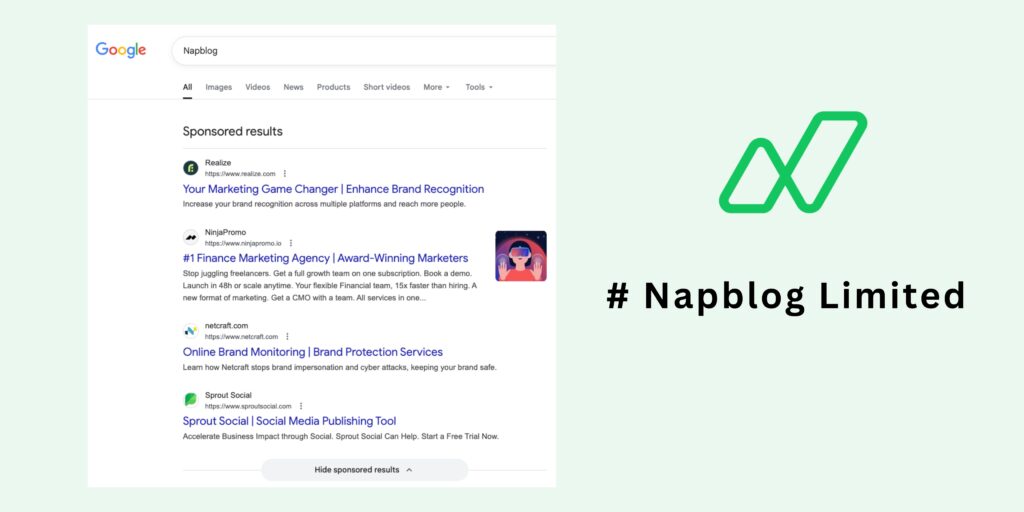
If you search “Napblog” on Google today, the first thing you see is not Napblog. You see sponsored results. You see polished promises.You see bold claims.You see agencies, platforms, tools, and dashboards competing aggressively for attention, keywords, and clicks. This is the modern marketing battleground. Whoever bids highest, appears first. Whoever shouts loudest, gets noticed. Whoever compresses the message into the sharpest headline, wins the impression. And yet—Napblog exists almost in opposition to this model. Napblog Limited was not built to win the sponsored results column. It was built to question whether that column should define trust, growth, or long-term brand value at all. This article is not about attacking competitors. It is about understanding what kind of company Napblog is, by contrasting it with what sponsored-result companies represent—and why a slower, system-led, operating-system-driven approach may quietly outlast them. The Sponsored Results Economy: What It Optimises For When you look at the sponsored results competing in the same keyword space as Napblog, a clear pattern emerges. Let us look at them conceptually. These are competent, well-funded, well-marketed organisations. They optimise for visibility. They optimise for reach. They optimise for immediate conversion clarity. And crucially—they optimise for external outcomes. Clicks.Leads.Impressions.Reports.Dashboards. The sponsored results economy is built on output metrics. Napblog is built on something far less visible. Napblog Does Not Compete for Clicks. It Competes for Continuity. Napblog Limited does not sell marketing as a service, nor does it sell marketing as a tool. Napblog builds operating systems for human effort. That distinction matters. Sponsored competitors focus on what happens after attention. Napblog focuses on what happens before consistency. Before campaigns.Before content calendars.Before ads.Before growth teams. Napblog starts at the level most marketing platforms ignore:daily execution behaviour. Napblog’s philosophy is simple, but uncomfortable for traditional marketing logic: If effort is not structured, no amount of amplification will compound. Where sponsored platforms promise acceleration, Napblog insists on alignment. Where agencies promise speed, Napblog enforces sequence. Why Sponsored Marketing Feels Effective—But Rarely Compounds Sponsored marketing works. There is no denial here. If you need visibility tomorrow, ads deliver.If you need pipeline this quarter, agencies help.If you need dashboards, tools provide them. But there is a hidden cost few companies openly discuss: dependency. Sponsored results reward the company that pays today—not the one that learns today. The moment spend stops, visibility collapses.The moment retainers end, execution fragments.The moment tools are removed, behaviour reverts. Napblog was designed specifically to address this structural fragility. Napblog’s Position Is Not “Against” These Companies — It Is Orthogonal Napblog does not aim to replace Sprout Social.It does not aim to out-advertise NinjaPromo.It does not compete with Realize on reach. Napblog exists below these layers. It operates at the execution infrastructure layer—the level where individual professionals, students, founders, and early teams build repeatable momentum before marketing even makes sense. In other words: Napblog is what you need before marketing starts working. The Difference Between Brand Exposure and Brand Formation Sponsored platforms help with brand exposure. Napblog focuses on brand formation. Exposure answers:“Who saw you?” Formation answers:“Who are you becoming—consistently?” Napblog treats brand not as a message, but as an accumulated by-product of disciplined action. This is why Napblog’s ecosystem looks less like a marketing tool and more like an operating system. None of these are glamorous. None of these are ad-friendly. But all of them compound. Why Napblog Does Not Promise Speed One of the loudest claims in sponsored results is speed. “Launch in 48 hours.”“Scale instantly.”“Get results fast.” Napblog refuses to promise speed. Instead, it promises trajectory. Trajectory is slower to explain, harder to sell, and nearly impossible to compress into a headline—but it is what actually determines outcomes over years. Napblog assumes: Sponsored marketing assumes stability. Napblog assumes reality. The Human Cost of Outsourced Momentum A subtle issue with agency-led and tool-led growth is outsourced accountability. When growth is externalised, learning slows internally. Napblog’s core belief is that sustainable brands are built when individuals: This is why Napblog appeals not just to companies—but to students, early professionals, founders, and researchers. It is not a platform that says “we will do it for you.” It is a system that says:“Let us make your effort measurable enough to trust yourself.” Why Napblog Rarely Shows Up in Sponsored Results—and Why That Is Intentional Napblog does not aggressively bid on its own name. This is not oversight. It is philosophy. Napblog believes that discovery should follow depth, not precede it. People who find Napblog tend to arrive through: This creates slower growth—but stronger alignment. Napblog would rather have 100 users who understand the system than 10,000 users who churn after curiosity fades. Sponsored Results Sell Solutions. Napblog Builds Capacity. The sponsored companies you see sell solutions: Napblog builds capacity: Capacity cannot be advertised easily. It must be experienced. The Long Game: Why Napblog Is Comfortable Being Misunderstood Early Napblog Limited is not optimised for virality. It is optimised for longevity. Companies built on ads must keep buying attention.Companies built on systems slowly become unavoidable. Napblog is deliberately patient because its value only becomes obvious after time has passed. That is uncomfortable in an ecosystem trained to measure success weekly. But it is honest. Final Thought: Sponsored Results Are Loud. Napblog Is Quiet by Design. When someone searches Google and sees Napblog surrounded by sponsored competitors, it can feel like Napblog is behind. In reality, Napblog is playing a different game. Sponsored companies compete for who appears first. Napblog competes for who lasts. And in a world where attention is rented but discipline is owned, that difference is not small. It is everything.

AI Europe OS Napblog Limited Germany AI Adoption
AIEOS - AI Europe OS

AI Europe OS and the Rising Demand for Artificial Intelligence in Germany

Germany stands at the center of Europe’s accelerating demand for artificial intelligence. As Europe’s largest economy and industrial powerhouse, Germany is simultaneously a primary beneficiary and a critical stress test for Europe’s ambition to build a sovereign, competitive, and trustworthy AI ecosystem. AI Europe OS emerges in this context not as a single product, but as an operating framework designed to align demand, infrastructure, regulation, talent, and sector-specific deployment under a coherent European model. This article examines AI Europe OS through the lens of Germany’s rapidly expanding AI demand, highlighting why Germany is pivotal to Europe’s AI future and how AI Europe OS can structure, scale, and de-risk AI adoption across the German economy. The German market illustrates both opportunity and constraint: strong industrial demand, world-class research, and deep capital coexist with fragmentation, skills shortages, SME adoption gaps, and increasing pressure for data sovereignty. AI Europe OS addresses these challenges by offering a structured, compliant, and interoperable foundation for AI deployment aligned with European values and regulatory realities. Germany’s AI Demand: A Structural Shift, Not a Trend The surge in AI demand in Germany is not cyclical. It is structural. Multiple forces converge to make AI a strategic necessity rather than a discretionary investment. First, Germany’s industrial model is under pressure. Export-driven manufacturing, once anchored in mechanical excellence, now competes in a world defined by software-defined products, digital twins, autonomous systems, and data-driven optimization. Productivity growth has slowed, global competition has intensified, and cost pressures have increased. AI is increasingly viewed as the only viable lever to sustain competitiveness without eroding quality or compliance. Second, Germany’s labor market dynamics reinforce this urgency. Demographic decline, skills shortages, and rising labor costs make automation and augmentation unavoidable. AI is not simply replacing tasks; it is compensating for missing capacity in engineering, planning, maintenance, logistics, and administrative functions. Third, regulatory and geopolitical realities have elevated “sovereign AI” from a policy concept to a procurement requirement. German enterprises and public institutions are increasingly unwilling to rely exclusively on non-European AI platforms for critical data, industrial IP, and citizen-facing services. AI Europe OS positions itself precisely at this intersection of industrial necessity, labor transformation, and sovereignty concerns. AI Europe OS: Conceptual Foundations AI Europe OS should be understood as a systemic framework rather than a monolithic platform. Its core purpose is to translate Europe’s AI ambition into deployable, scalable, and compliant systems across member states, with Germany as a primary demand anchor. At its foundation, AI Europe OS integrates five layers: Germany’s AI demand directly maps onto each of these layers, making it an ideal proving ground for AI Europe OS. Industrial Demand: Manufacturing, Automotive, and Industry 4.0 Germany’s strongest AI demand originates in its industrial core. Manufacturing and automotive sectors are undergoing a transition from automation to autonomy. In smart factories, AI is deployed for predictive maintenance, quality inspection, process optimization, and energy efficiency. Computer vision systems identify defects at scales and speeds impossible for human inspectors. Machine learning models forecast equipment failures, reducing downtime and extending asset lifecycles. In automotive and mobility, AI enables autonomous driving functions, battery optimization, software-defined vehicles, and intelligent supply chain orchestration. AI Europe OS provides a standardized environment where such systems can be developed, validated, and deployed in compliance with European safety and liability standards. Crucially, Germany’s industrial firms require AI systems that integrate with legacy operational technology, comply with strict certification regimes, and remain auditable over decades. AI Europe OS addresses this by emphasizing lifecycle governance and interoperability rather than experimental agility alone. Mittelstand and SMEs: The Adoption Gap While large German corporations lead AI investment, the Mittelstand faces structural barriers. These include limited capital, lack of in-house AI expertise, uncertainty around regulatory obligations, and unclear return on investment. AI Europe OS is designed to close this gap. By offering pre-validated AI components, shared infrastructure, and compliance-by-design architectures, it reduces the cost and risk of adoption for smaller firms. SMEs can deploy AI for demand forecasting, customer service automation, logistics optimization, and quality assurance without building full-stack AI capabilities internally. In Germany, where SMEs account for a substantial share of employment and exports, closing this adoption gap is not optional. Without it, AI-driven productivity gains will remain concentrated, exacerbating regional and sectoral inequality. Public Sector and Critical Infrastructure Germany’s public sector represents a growing source of AI demand, driven by digital government initiatives, demographic pressure on public services, and security considerations. AI applications in public administration include document processing, benefits management, fraud detection, urban planning, and citizen interaction. In healthcare, AI supports diagnostics, hospital logistics, and resource planning. In energy and transport, AI optimizes grid stability, traffic management, and predictive maintenance. AI Europe OS provides a framework that allows public institutions to procure and deploy AI systems with legal certainty, transparency, and accountability. This is particularly critical in Germany, where constitutional protections, data privacy expectations, and public scrutiny are exceptionally strong. Sovereign AI: From Strategy to Procurement Criterion Germany’s emphasis on sovereign AI is not ideological; it is operational. Enterprises and public bodies increasingly require assurances regarding data residency, model governance, and vendor independence. AI Europe OS operationalizes sovereignty by: This approach allows Germany to reduce strategic dependencies while remaining integrated into global innovation ecosystems. Talent, Skills, and Workforce Transformation Germany’s AI demand is constrained by talent availability. Data scientists, AI engineers, MLOps specialists, and AI-literate managers are in short supply. At the same time, millions of workers require reskilling as AI reshapes tasks rather than eliminating entire professions. AI Europe OS incorporates workforce enablement as a core component. This includes standardized training pathways, sector-specific AI literacy programs, and tools that allow domain experts to interact with AI systems without deep technical knowledge. By lowering the skill threshold for effective AI use, AI Europe OS helps Germany scale adoption without waiting for an unrealistic expansion of elite AI talent. Regulatory Alignment as Competitive Advantage The EU AI Act is often portrayed as a constraint. In Germany, it is increasingly understood as a market-shaping instrument. Enterprises that