Napblog

January 20, 2026

AIEOS: DAEMAD SERVICES as an Enterprise Enablement Layer for the European Construction Industry
AIEOS - AI Europe OS

AIEOS: DAEMAD SERVICES as an Enterprise Enablement Layer for the European Construction Industry

The European construction sector stands at a structural inflection point. Confronted by persistent productivity gaps, labour shortages, escalating material costs, sustainability mandates, and a tightening regulatory environment, construction enterprises are being compelled to modernise faster than at any point in the last fifty years. Artificial intelligence is no longer an experimental capability in this context; it is an operational necessity. AI Europe OS, positioned as a continental-grade operating framework for compliant, sovereign, and industry-aligned artificial intelligence, provides the architectural foundation for this transition. Within this framework, DAEMAD SERVICES functions as a domain-specific enterprise enablement layer—bridging policy, technology, and real-world construction workflows. This perspective outlines how AI Europe OS, delivered through DAEMAD SERVICES, enables construction enterprises to adopt AI safely, legally, and profitably—while remaining fully aligned with the EU AI Act, GDPR, and Europe’s broader digital sovereignty objectives. 1. The Structural Challenges Facing Europe’s Construction Industry Despite representing nearly 10% of the EU’s GDP, the construction industry remains one of Europe’s least digitised sectors. The challenges are systemic rather than cyclical: Traditional enterprise software has addressed parts of this problem, but not its structural core. AI introduces the ability to anticipate, optimise, and automate across the full construction lifecycle—provided it is implemented responsibly and in compliance with European law. This is where AI Europe OS reframes the question from “Which AI tools should we buy?” to “How do we operationalise AI as regulated infrastructure?” 2. AI Europe OS: A Regulated Operating System for Enterprise AI AI Europe OS is not a single application or model. It is a systems architecture designed to: Under the EU AI Act, many construction-related AI systems fall into high-risk categories, including: AI Europe OS ensures that these systems are deployed with: DAEMAD SERVICES operationalises this architecture specifically for construction enterprises. 3. DAEMAD SERVICES: Translating AI Europe OS into Construction Reality DAEMAD SERVICES acts as the industry execution layer of AI Europe OS for construction. Its role is not to replace existing platforms, but to orchestrate them within a compliant, AI-enabled operating environment. From an enterprise perspective, DAEMAD SERVICES delivers value across four dimensions: Each dimension is underpinned by governed AI services rather than isolated tools. 4. Pre-Construction: From Estimation to Strategic Intelligence In the pre-construction phase, margins are determined long before ground is broken. AI Europe OS enables DAEMAD SERVICES to integrate AI-driven intelligence into feasibility, bidding, and planning—without violating procurement transparency rules. Key capabilities include: Platforms such as Oracle Construction and Engineering and Building Radar already provide advanced analytics. DAEMAD SERVICES integrates these capabilities into AI Europe OS so that outputs are explainable, auditable, and compliant with EU requirements. 5. Project Management: Predictive, Not Reactive Construction project management has historically been reactive. AI fundamentally changes this by enabling predictive control systems. Through DAEMAD SERVICES, AI Europe OS supports: Enterprise platforms such as Procore and Wrike already incorporate AI features. Within AI Europe OS, these are governed as regulated decision-support systems, ensuring human oversight and legal defensibility. 6. On-Site Operations: Safety, Compliance, and Real-Time Intelligence On-site operations represent the highest-risk environment under the EU AI Act. AI Europe OS therefore enforces particularly strict governance here. DAEMAD SERVICES enables: These systems are deployed with: This approach aligns with guidance from European digital construction initiatives such as EU Build Up, which emphasise responsible digitalisation rather than unchecked automation. 7. Post-Construction: From Assets to Intelligent Infrastructure The construction relationship no longer ends at handover. AI Europe OS enables a shift toward lifecycle-based value models. Through DAEMAD SERVICES, enterprises can offer: This not only improves building performance but creates recurring revenue streams—while supporting EU sustainability objectives. 8. Governance and Compliance: AI as Regulated Infrastructure The defining characteristic of AI Europe OS is that compliance is not an afterthought. DAEMAD SERVICES ensures that construction enterprises can demonstrate: This transforms AI from a regulatory liability into a governed enterprise asset. 9. Strategic Impact for European Construction Enterprises By adopting AI Europe OS through DAEMAD SERVICES, construction enterprises achieve: Crucially, this is achieved without vendor lock-in and without compromising European data sovereignty. 10. Conclusion: Building Europe’s AI-Native Construction Sector AI will not replace Europe’s construction workforce. It will augment it—if deployed responsibly. AI Europe OS establishes the governance foundation. DAEMAD SERVICES translates that foundation into operational capability for the construction industry. Together, they offer a credible, European alternative to fragmented, opaque, and non-compliant AI adoption. For construction enterprises navigating rising complexity, tighter margins, and regulatory scrutiny, this approach does not merely enable digital transformation—it enables long-term competitiveness within Europe’s evolving industrial and legal landscape.
SIOS financial security, and confidence Napblog Limited
SIOS - Students Ireland OS

The Missing Link: How the Lack of Real-World Experience Is Failing Students in Ireland

A SIOS Perspective | January 2026 Across Ireland, students are doing what they have always been told to do: attend lectures, submit assignments, pass exams, and graduate with the expectation that a degree will unlock opportunity. Yet, for a growing number of students, graduation marks not the beginning of stability, but the start of uncertainty. At the centre of this issue is a persistent and systemic problem: the lack of meaningful real-world experience embedded within Irish higher education. From Students Ireland OS (SIOS)’s perspective, this is no longer a marginal concern or an abstract policy debate. It is a lived reality shaping student wellbeing, employability, financial security, and confidence in the education system itself. 1. The Illusion of Preparedness Irish higher education continues to excel academically. Degrees remain internationally respected, institutions perform well in research rankings, and lecture content is often rigorous and intellectually demanding. However, academic excellence alone is no longer sufficient in a labour market that prioritises adaptability, applied skills, and experience. Students routinely report feeling “qualified but unprepared.” They graduate with strong theoretical knowledge yet lack exposure to: This disconnect fosters a dangerous illusion of preparedness. Students assume that a degree equates to readiness, only to encounter repeated rejections due to “insufficient experience” for even entry-level roles. According to reporting by The Irish Times, more than four in ten students believe college does not adequately prepare them for employment. This statistic reflects a structural failure, not individual shortcomings. 2. The Skills Gap Employers Won’t Ignore Employers across sectors consistently emphasise the same deficiencies: Ironically, these are not advanced or niche skills. They are foundational workplace competencies that should be developed during education, not discovered by trial and error after graduation. Many students encounter a paradox: “You need experience to get a job, but you need a job to get experience.” Without structured placements, paid internships, or industry-linked projects, students from non-privileged backgrounds are especially disadvantaged. Informal networks and unpaid opportunities remain inaccessible luxuries for many. 3. Financial Pressure Intensifies the Experience Gap The lack of real-world experience does not exist in isolation. It is deeply intertwined with Ireland’s cost-of-living and housing crises. Students are increasingly forced to prioritise survival over skill-building: For many, unpaid internships or low-paid placements are simply not viable. While work experience is often framed as a solution, it becomes inaccessible when students must choose between career development and paying rent. Support mechanisms such as SUSI provide essential assistance, but they do not address the structural absence of paid, integrated experiential learning within degree programmes. 4. Transition Shock: From Structured Learning to Unstructured Reality A recurring theme in student feedback is “transition shock.” College provides: The working world offers none of this clarity. Students suddenly face: Institutions often celebrate “employability” in brochures, yet practical preparation for adult responsibilities—contracts, taxes, budgeting, workplace rights—is minimal or optional at best. This gap leaves graduates feeling overwhelmed and unsupported during one of the most critical transitions of their lives. 5. Mental Health: The Invisible Consequence The psychological impact of feeling unprepared cannot be overstated. Financial stress, employment uncertainty, and perceived failure contribute to rising anxiety among students and graduates. Reports from organisations such as National Youth Council of Ireland consistently highlight how young people feel disproportionately affected by housing instability, insecure work, and policy decisions made without youth input. When students internalise systemic failures as personal inadequacy, the result is: 6. The Pandemic Effect: A Lost Layer of Experience Students who studied during or immediately after the COVID-19 pandemic face an additional disadvantage. Remote learning, cancelled placements, and reduced campus engagement eliminated informal learning opportunities that previous cohorts took for granted. For many, university became transactional: The loss of in-person collaboration, networking, and extracurricular involvement widened the experiential gap. While academic content continued, the social and professional dimensions of education were severely weakened. 7. Unequal Impact on Marginalised Students The absence of structured real-world learning disproportionately affects: Organisations such as AHEAD have repeatedly highlighted accessibility gaps in placements, internships, and professional preparation. When experiential learning is optional rather than embedded, those who most need institutional support are left to navigate complex systems alone. 8. Why This Is a Systemic Failure From a SIOS perspective, it is insufficient to advise students to “be more proactive” or “seek opportunities independently.” The responsibility cannot rest solely on individuals operating within constrained financial and social conditions. This is a systemic issue rooted in: Education systems must evolve alongside labour markets, not lag behind them. 9. What Needs to Change SIOS advocates for a shift from optional employability to embedded preparedness. This includes: 1. Paid, Credit-Bearing Work Placements Every degree should integrate structured, paid placements aligned with the field of study. 2. Practical Assessment Reform Assessment should value applied problem-solving, teamwork, and real-world outputs—not solely essays and exams. 3. Career Preparation as Core Curriculum Career literacy, financial skills, and workplace rights should be mandatory, not extracurricular. 4. Stronger Employer Accountability Industry must engage meaningfully with education, offering accessible, paid opportunities rather than extractive internships. 5. Student Voice in Policy Design Students must be active participants in shaping employability strategies, not passive recipients of decisions made about them. 10. Reframing the Purpose of Higher Education Higher education should not be reduced to job training—but neither can it ignore employment realities. The purpose of college must be rebalanced to prepare students for: A degree should be a bridge to society, not a cliff edge. Conclusion: From Credentials to Capability Ireland’s students are capable, motivated, and resilient. What they lack is not ambition, but a system that translates education into lived capability. The lack of real-world experience is not a minor flaw—it is a fault line running through the student experience. If left unaddressed, it risks eroding trust in higher education and deepening inequality across generations. Students Ireland OS calls for urgent, coordinated reform. Preparing students for the real world is not an optional enhancement—it is a core responsibility. The question is no longer whether change is needed, but whether institutions are willing to act

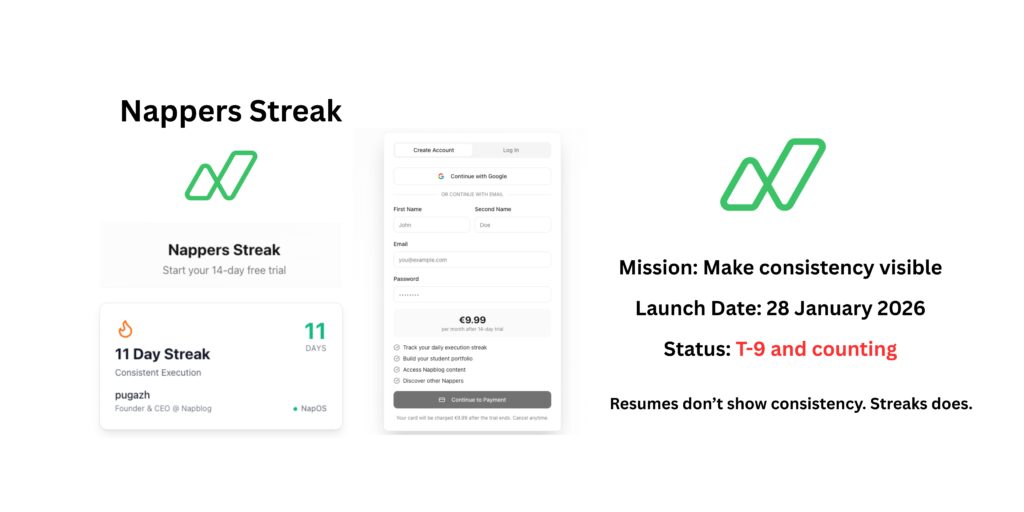
Nap OS -> Nappers Streak Mission: Make consistency visible Launch Date: 28 January 2026 Status: T-9 and counting
NapOS

T-9: Why Students, Job Seekers, and Freelancers Must Start Nappers Streak — Now

Mission: Make consistency visibleLaunch Date: 28 January 2026Status: T-9 and counting This is not a motivational article.This is not productivity advice.This is a reality check. If you are a student, job seeker, or freelancer, you are not losing because you lack intelligence or ambition. You are losing because your daily effort is invisible. And in today’s world, what cannot be seen cannot be rewarded. Nappers Streak exists to solve that problem. This article explains 100 reasons why starting Nappers Streak now—not after launch, not after confidence, not after “one more course”—is how you build momentum to work like hell and advertise without talking. The Core Truth (Read This Slowly) Hard work does not compound automatically.Consistency does not advertise itself.Effort without visibility disappears. Nappers Streak turns daily execution into proof. Below are 100 real, practical, no-nonsense reasons why this matters. SECTION 1: WHY STUDENTS MUST START (1–35) SECTION 2: WHY JOB SEEKERS MUST START (36–70) SECTION 3: WHY FREELANCERS MUST START (71–100) The Philosophy: Work Like Hell and Advertise (Without Talking) Most people misunderstand advertising. Advertising is not shouting.Advertising is evidence repeated over time. Nappers Streak lets you: No exaggeration.No storytelling.No justification. Just proof. Why T-9 Matters (Why Start Before Launch) Starting early does three things: By launch day, you are not trying Nappers Streak.You are already a Napper. Final Countdown Message This launch is not about features.It is about making daily effort visible. If you are: Then your streak is not optional.It is your leverage. 🚀 T-9 and counting. Start showing up.Let consistency speak.Let the streak do the advertising. Launch: 28 January 2026

Homeschooling Movement China Success
HOS - Homeschooling OS

China Strategy: How an Unofficial Homeschooling Movement Is Quietly Strengthening the Economy

A natural, systems-level conversation about education, economics, and the future of work in China When people talk about China’s economic strategy, the conversation usually centers on industrial policy, manufacturing scale, artificial intelligence, or geopolitics. Education is mentioned, but often only in abstract terms—exam reform, STEM investment, or university rankings. What is far less discussed, yet increasingly influential, is a quiet, bottom-up shift happening inside Chinese households: homeschooling. Officially, homeschooling in China does not exist. Compulsory education laws require children to attend state-approved schools. And yet, across major cities—Beijing, Shanghai, Shenzhen, Hangzhou—thousands of families are opting out, quietly, deliberately, and with a clear economic logic in mind. This article, written through the lens of HomeSchooling OS, does not argue that homeschooling is a formal Chinese state policy. It is not. Instead, it explores something more subtle and arguably more powerful: how a growing, parent-driven homeschooling movement is aligning—intentionally or not—with China’s long-term economic transformation goals. What we are witnessing is not rebellion. It is adaptation. 1. The Economic Context: Why Education Became a Pressure Point China’s economy is in transition. The old model—low-cost manufacturing, demographic dividends, and rapid urbanization—has reached its natural limits. In response, policymakers now emphasize what they call “new productive forces”: artificial intelligence, advanced manufacturing, biotechnology, and high-value services. This shift creates a structural mismatch. On one side, the economy needs creative problem-solvers, interdisciplinary thinkers, and people who can work with AI rather than be replaced by it. On the other side, the traditional education system still rewards endurance, obedience, and exam performance above all else. The result is visible everywhere: For many middle-class Chinese parents, this mismatch is no longer theoretical. It is personal. 2. Why Parents Are Opting Out: A Rational Economic Choice Chinese parents are not rejecting education. They are rejecting misaligned education. The typical school day in urban China can stretch to ten hours or more. Evenings are filled with homework and weekend tutoring. The system is optimized for one goal: success in the national university entrance exam. But increasingly, parents are asking a simple question: “If my child succeeds at every exam but cannot thrive in the future economy, what have we actually achieved?” Homeschooling emerges here not as ideology, but as strategy. Parents describe three core motivations: From a HomeSchooling OS perspective, this is classic system optimization: eliminating waste, increasing signal-to-noise ratio, and reallocating resources toward future value. 3. From Rote Learning to “New Productive Forces” One of the most striking features of Chinese homeschooling families is what replaces school time. This is not unstructured learning. In fact, many homeschooling schedules are more intentional than public school timetables. Common focus areas include: These choices mirror, almost perfectly, the skills China says it wants to cultivate at a national level. This alignment matters. Homeschooling allows: In economic terms, families are acting as micro-incubators of human capital. 4. Escaping the Exam Trap and Talent Misallocation China’s exam system is exceptionally effective at ranking students. It is far less effective at discovering what each student is actually good at. This leads to talent misallocation: Homeschooling directly addresses this inefficiency. Instead of forcing all children through a single narrow funnel, homeschooling families design learning around individual capability. A mathematically gifted child accelerates. A linguistically inclined child deepens. A physically oriented child trains without stigma. From an economic standpoint, this matters more than grades. A system that produces fewer “perfect students” but more capable individuals is better suited for a volatile, innovation-driven economy. 5. Household Investment as an Economic Signal Another overlooked dimension is where the money goes. Homeschooling in China is resource-intensive. Families invest heavily in: This spending does not disappear. It flows into: In other words, homeschooling families are actively stimulating a parallel education economy—one aligned with personalization, technology, and services rather than mass standardization. This is precisely the type of domestic demand China wants to cultivate. 6. The Legal Gray Zone: Why This Is Still Fragile Despite its economic logic, homeschooling in China exists in a regulatory gray zone. Compulsory education laws remain strict. While local authorities often tolerate individual cases—especially when families maintain low visibility—the risk of policy tightening always exists. This creates three constraints: From a HomeSchooling OS perspective, this is a governance mismatch. The system benefits from experimentation but has not yet created safe channels for it. 7. Equity: The Uncomfortable Question It would be irresponsible to ignore the equity issue. Homeschooling in China is overwhelmingly a middle- and upper-middle-class phenomenon. These families possess: Meanwhile, working-class families remain dependent on the public system, regardless of its limitations. This creates a risk: If homeschooling remains unofficial and exclusive, its benefits will not scale nationally. From an economic standpoint, this caps its impact. 8. How the State Is Responding—Indirectly Interestingly, the Chinese government’s recent education reforms echo many homeschooling critiques: This suggests recognition of systemic strain. Rather than legitimizing homeschooling directly, the state appears to be absorbing its lessons and integrating them into public reform. In systems theory terms, homeschooling functions as an external feedback loop. 9. Homeschooling OS Lens: What This Really Represents From a HomeSchooling OS standpoint, China’s homeschooling trend is not about ideology, freedom, or Westernization. It is about adaptive capacity. Families are responding rationally to: They are redesigning education at the household level because centralized systems move slowly, while children grow fast. This is not unique to China—but in China’s scale and context, it is especially consequential. 10. Strategic Implications for the Chinese Economy If managed carefully, this trend could: If suppressed entirely, it risks: The optimal path likely lies somewhere in between: controlled flexibility, modular education options, and state-recognized alternative pathways. Conclusion: A Quiet Force Shaping the Future Homeschooling in China is not a headline policy. It is a signal. It signals that families understand something deeply important: education is no longer about surviving exams, but about surviving economic change. Whether or not homeschooling ever becomes legal or mainstream, its influence is already visible—in parental expectations, education markets, and reform discourse. From the perspective of HomeSchooling OS,

Nap OS – Nappers Streak Sync Digital Card for LinkedIn
NapOS

Nap OS – Nappers Streak Sync Digital Card for LinkedIn

Executive Summary In a market where recruiters, hiring managers, and clients are overwhelmed with static resumes and outdated portfolios, consistency has become the true signal of capability. Nap OS introduces the Nappers Streak Sync Digital Card as a living, auto-updating professional identity layer that integrates directly with LinkedIn via a personalized link. This card reflects a user’s daily execution, learning velocity, and outcome-oriented progress in real time. This article explains what the Nappers Streak Sync Digital Card is, how it works inside Nap OS, why LinkedIn is the right distribution surface, and—most importantly—how consistent momentum converts into interviews, jobs, freelance clients, and tangible career outcomes. 1. The Problem with Static Professional Profiles Most professional profiles suffer from three structural limitations: Recruiters and clients increasingly ask the same silent question: “Is this person actively building, learning, and executing right now—or just describing what they did in the past?” Nap OS is designed to answer this question transparently. 2. What Is the Nappers Streak Sync Digital Card? The Nappers Streak Sync Digital Card is a dynamic, web-based professional card generated inside Nap OS and shared externally via a personalized, permanent link. When added to LinkedIn (Featured section, About section, or Experience links), it becomes a live proof-of-work layer. Core Characteristics This is not a badge. It is not a vanity metric. It is an execution ledger. 3. How the Streak Sync Works Inside Nap OS Nap OS operates as an execution operating system rather than a content platform. Every user action contributes to a measurable streak. Inputs That Feed the Streak Each completed action reinforces the streak. Missed days weaken momentum—not through punishment, but through visible reality. Output on the Digital Card The card displays: This transforms invisible effort into visible credibility. 4. Why LinkedIn Is the Distribution Layer LinkedIn already functions as the world’s default professional graph. However, it lacks one thing: real-time execution data. The Nappers Streak Sync Digital Card does not replace LinkedIn. It upgrades it. Strategic Placement on LinkedIn This allows recruiters and clients to self-qualify interest before initiating contact. 5. Momentum as a Career Asset Momentum is not motivation. Momentum is evidence of continuity. Why Momentum Beats Talent The streak transforms effort into a visible career asset. 6. How Momentum Converts into Interviews Recruiters scan hundreds of profiles daily. Most look identical. When a recruiter clicks a Nappers Streak Sync link, they see: This reframes the conversation from: “Tell me about yourself” to: “I’ve been following your work. Let’s talk.” Interviews become invitations, not applications. 7. How Momentum Converts into Jobs Hiring is risk management. The streak reduces risk by showing: A candidate with a visible 90-day streak is statistically more likely to: Nap OS turns consistency into a hiring signal. 8. How Momentum Converts into Freelance Clients Clients do not buy potential. They buy reliability. A live streak card shows: This positions the Napper as an operator, not a pitch deck. 9. Tangible Results from Consistent Motion Momentum produces second-order effects: The streak does not just display progress—it creates it. 10. Psychological Advantage of the Streak Consistency externalized removes internal negotiation. Nap OS leverages behavioral reinforcement, not willpower. 11. Why This Works in a Noisy Market In an AI-saturated, resume-inflated market: The Nappers Streak Sync Digital Card creates asymmetry in favor of disciplined builders. 12. From Streaks to Career Compounding Short-term effort feels linear. Long-term consistency compounds. Nap OS is designed to carry users across these horizons. 13. The Strategic Shift: From Profile to System Traditional platforms optimize for presentation. Nap OS optimizes for execution. The Digital Card is simply the visible edge of a deeper operating system designed to: 14. Who This Is For If consistency is your strength, this system amplifies it. 15. Final Perspective The future of professional credibility will not be built on static documents. It will be built on visible systems of execution. The Nappers Streak Sync Digital Card is not a feature. It is a philosophical shift—from claiming value to demonstrating it daily. Momentum is no longer invisible. With Nap OS, consistency becomes your loudest credential.

Napblog Logo
Blog

How Pugazheanthi Palani’s multi-domain thinking, anchored in marketing, shaped Napblog?

people are taught to specialise early. Pick a lane. Optimise for a role. Accumulate credentials that signal narrow competence. This approach creates employability, but it rarely creates originality. Napblog exists because its founder did not follow that instruction. The story of Napblog is not the story of a single product idea. It is the outcome of years spent interpreting multiple domains through one core lens: marketing as applied human behaviour. Not marketing as promotion. Not marketing as growth hacks. But marketing as the discipline that sits at the intersection of psychology, systems, economics, design, and execution. This article explores how that interpretative approach shaped Napblog — and why multi-domain literacy, when anchored correctly, compounds into a strategic advantage rather than confusion. Marketing as the Core Lens, Not the Department Most people misunderstand marketing because they encounter it too late — after a product exists, after a resume is written, after a service is already defined. For Pugazheanthi, marketing came first. Marketing was not treated as a function but as a framework for understanding incentives, attention, trust, and timing. Every other domain was interpreted through this frame: This is critical. When marketing becomes the core interpretive layer, domain knowledge stops being siloed. Each new field becomes a translation problem rather than a reinvention. Napblog did not emerge from “building an app.”It emerged from observing how people fail to convert effort into opportunity, even when they are capable. Multi-Domain Exposure Without Fragmentation A common failure mode of multi-domain thinkers is fragmentation: too many ideas, no centre of gravity. What prevented that here was discipline. Across education, career development, content systems, operating systems, analytics, and product thinking, one question remained constant: “What behaviour does this system reward — and what behaviour does it punish?” This question applies equally to: By repeatedly asking it, patterns emerge. Those patterns formed the philosophical backbone of Napblog. From Observation to System Design Napblog’s philosophy did not come from theory. It came from watching real people: The insight was uncomfortable but clear: Opportunity does not reward potential.Opportunity rewards visible, repeated execution. Marketing training sharpened this insight. In marketing, what is not visible does not exist. The same rule applies to careers. Napblog was designed to make execution visible — not performative, not gamified, but accountable. Why Interpretation Matters More Than Expertise Expertise answers questions inside a domain.Interpretation connects domains together. Pugazheanthi’s strength was not being the best engineer, designer, or academic. It was being able to interpret each discipline’s incentives and limitations, then design systems that aligned them. Examples: Napblog is the result of this synthesis. Marketing as Behavioural Engineering Traditional marketing focuses on awareness and conversion. Napblog applies marketing upstream, before products, before careers, before outcomes. It asks: This is behavioural engineering. Instead of telling users to “be consistent,” Napblog embeds consistency into the operating environment. Instead of encouraging discipline, it structures discipline as the path of least resistance. That design philosophy is pure marketing — but invisible. The Birth of Napblog as an Ecosystem, Not a Tool Another interpretative decision shaped Napblog early: do not build features; build an ecosystem. This came directly from marketing thinking. Single-feature products compete on novelty. Ecosystems compete on switching cost and identity. Napblog was positioned as: Not one of these alone — all of them together. This is why Napblog is not explained easily in a sentence. And that is intentional. Strong systems are felt before they are understood. Founder-Led Execution as Proof Marketing taught another non-negotiable rule: the messenger matters as much as the message. Napblog’s founder did not outsource credibility. He led from the front: This was not personal branding. It was system validation. If the system works, it must work first for the person who designed it. This founder-led execution model shaped Napblog’s culture. Users are not asked to do anything the system itself does not enforce. Why Marketing Anchors Multi-Domain Thinking Marketing is uniquely positioned to anchor multi-domain interpretation because it: When marketing is treated seriously — not as promotion, but as applied human understanding — it becomes the glue between disciplines. Napblog exists because that glue was never removed. Inspiration Without Motivation Napblog does not aim to motivate. Motivation is unreliable. Instead, it aims to design inevitability: This is not optimism. It is pattern recognition. The inspiration people feel when encountering Napblog is not emotional hype. It is relief — relief that effort no longer disappears into silence. What Napblog Ultimately Represents Napblog is the product of: It demonstrates a simple but rare truth: When domain knowledge is interpreted through human behaviour,systems emerge that outlast trends, platforms, and tactics. This is why Napblog resonates with students, professionals, founders, and recruiters alike. Not because it promises outcomes — but because it structures the path that reliably produces them. Closing Reflection In an era obsessed with specialisation, Napblog stands as a counter-example. It shows that breadth, when anchored by a strong interpretive core, does not dilute impact — it multiplies it. Marketing was that core. Not marketing as noise, but marketing as understanding. And from that understanding, Napblog was shaped — deliberately, patiently, and visibly. — Napblog Limited continues to evolve as an execution ecosystem built on proof, consistency, and human-first system design.