
Napblog

January 19, 2026

Nap OS Intelligence sync with NapPostman
NapOS

NapPostman: Turning APIs Into Proof, and Effort Into Outcomes

The Gap Between Learning and Outcomes Modern careers—especially in technology—do not fail because of a lack of learning resources. They fail because of fragmentation. Students learn APIs.Developers test endpoints.Freelancers write documentation.Job seekers prepare portfolios. But these efforts remain isolated. They live inside tools that do not talk to each other, do not compound over time, and do not translate learning into outcomes such as interviews, paid work, or long-term credibility. Nap OS was built to solve this structural gap. At the center of this shift is NapPostman—an API Portfolio Engine that transforms everyday Postman work into verified career proof, synchronized with Nap OS Intelligence, continuously updating MyPortfolio, and amplified across 40+ NapStore applications. NapPostman is not another API tool.It is a career execution layer. What Is NapPostman? NapPostman is an API Portfolio System inside Nap OS that connects directly to your Postman workspace and converts: into structured portfolio artifacts that can be reviewed, showcased, and reused across hiring, freelancing, and learning workflows. Instead of APIs being something you practice, they become something you prove. Instead of learning being temporary, it becomes compounding. From Activity to Evidence: Why API Work Deserves a Portfolio Most API work today disappears the moment the tab is closed. NapPostman changes the unit of value. The unit is no longer “requests sent.”The unit becomes capability demonstrated. Every synced collection becomes: This is the philosophical core of Nap OS:Work should accumulate, not reset. How NapPostman Syncs With Nap OS Intelligence NapPostman is not a standalone app. It is deeply integrated with Nap OS Intelligence, which continuously analyzes user activity across the OS. When you connect Postman to NapPostman: This creates a closed feedback loop: Learn → Execute → Capture → Improve → Repeat No manual curation.No rewriting effort.No context switching. MyPortfolio: A Living, Self-Updating Career Asset Traditional portfolios are static. They require: MyPortfolio inside Nap OS is dynamic. As you work inside NapPostman: Whether your target is: Your portfolio reorganizes itself accordingly. This is not presentation-first.It is truth-first. Four Career Tracks, One System NapPostman supports multiple career outcomes without fragmenting effort. 1. Backend Internship Track API fundamentals, clean request structures, environment usage, and learning progression are emphasized. Your portfolio highlights: 2. Full-Stack Role Track End-to-end API usage is showcased. Your portfolio demonstrates: 3. API Security & Testing Track Security is treated as a first-class signal. Artifacts emphasize: 4. Freelance API Tester Track Professional readiness becomes the focus. Your portfolio highlights: The same API work can serve multiple tracks—because Nap OS reframes it based on intent, not effort duplication. The NapStore Effect: 40+ Apps, One Compounding System NapPostman does not exist in isolation. It connects with over 40 native NapStore applications, each extending the value of your API work. Examples include: The result is a network effect. One API collection feeds: This is how Nap OS compounds effort. Nappers Streak: Consistency as a Career Strategy Most people fail not because they lack talent—but because they lack consistency. Nap OS introduces Nappers Streak, a system-wide consistency engine that tracks meaningful execution, not vanity activity. When you: Your streak increases. This streak is not cosmetic. It feeds into: Nap OS treats consistency as an asset, not a motivational slogan. From Learning to Interviews: Closing the Execution Gap Traditional learning paths end with certificates. Nap OS ends with outcomes. NapPostman helps close the gap by ensuring that: When recruiters or clients view a Nap OS portfolio, they do not see claims. They see: This shifts the conversation from:“Can you do this?”to“Walk me through how you did this.” That is the difference between hope-based hiring and proof-based hiring. Freelancers: From One-Off Gigs to Compounding Credibility Freelancers often restart credibility from zero with every client. NapPostman changes that. Each completed API testing effort becomes: Over time: Nap OS turns freelancing from transactional work into a reputation system. A Different Philosophy: Nap OS as a Career Operating System Nap OS is not a productivity app.It is not a learning platform.It is not a portfolio website. It is an operating system for career execution. NapPostman embodies this philosophy by ensuring that: Every Nap OS app exists to reduce friction between effort and results. Who NapPostman Is For? NapPostman is designed for: If your goal is: NapPostman is not optional. It is foundational. The Long-Term Vision NapPostman is only the beginning. As Nap OS Intelligence evolves, API work will increasingly drive: The system learns with you. Your work teaches the OS.The OS improves your outcomes. That is the future Nap OS is building. Final Thought: Work That Stays With You Most systems extract effort and leave nothing behind. Nap OS is different. Every API you test, every collection you refine, every streak you maintain—stays with you. NapPostman ensures that your work does not vanish into tools.It becomes identity, evidence, and leverage. This is not about working harder. It is about working once—and benefiting many times. Welcome to NapPostman.Welcome to Nap OS.
SIOS institutional level remains fragmented.
SIOS - Students Ireland OS

AI and Grading in Irish Universities: A Student-Led Perspective from Students Ireland OS (January 2026)

By January 2026, artificial intelligence has moved from being an optional digital aid to an unavoidable presence in Irish higher education. For university students across Ireland, AI tools are no longer futuristic novelties; they are embedded in daily academic life, from drafting ideas and checking grammar to organising research and managing workloads. However, this rapid integration has exposed a critical fault line in the Irish higher education system: grading and assessment. From the perspective of Students Ireland OS (SIOS), the current AI–grading crisis is not simply about cheating or academic misconduct. It is about uncertainty, inconsistency, and a widening gap between institutional policy and student reality. Students are navigating a system where the rules around AI use are often unclear, enforcement varies by institution and lecturer, and the consequences can be severe and life-altering. The result is a climate of anxiety that undermines trust in grading, fairness, and academic integrity itself. This article examines the AI-related grading problems faced by Irish university students as of January 2026, situating them within national policy debates, institutional responses, and the lived experiences of students. The Rapid Normalisation of AI in Student Work Generative AI tools are now as commonplace as spellcheckers once were. Students use AI for: For many students, particularly those balancing part-time work, commuting, or financial stress, AI feels less like a shortcut and more like a survival tool. Yet universities have struggled to articulate where legitimate assistance ends and academic misconduct begins. From a student perspective, the problem is not wilful dishonesty but rule ambiguity. Most institutional guidelines permit “limited” or “supportive” AI use but fail to define these terms with sufficient precision. As a result, students are often left guessing whether their use of AI will be deemed acceptable or punished retrospectively. Ambiguous Rules and the Fear of Accidental Misconduct One of the most significant grading-related problems students face is the lack of standardised, transparent guidance on AI use. While national bodies such as the Higher Education Authority have promoted AI literacy and ethical adoption, implementation at institutional level remains fragmented. Across Irish universities: This inconsistency places students in an impossible position. A practice considered acceptable in one module may be penalised in another. Worse still, students often discover violations only after grades are released or disciplinary processes begin. From the SIOS perspective, this creates a form of accidental plagiarism, where students unintentionally breach rules that were never clearly communicated. The psychological toll is significant, particularly for first-year students and international students unfamiliar with Irish academic norms. AI Detection Tools and the Crisis of Trust Compounding the problem is the widespread adoption of AI detection software. These tools claim to identify AI-generated text, yet their reliability remains highly contested within academic research. False positives are well-documented, particularly for: Despite these limitations, AI detection tools are increasingly being used as evidence in grading disputes and misconduct hearings. In late 2025 and early 2026, Irish media outlets including RTÉ and The Irish Independent reported hundreds of suspected cases of unauthorised AI use across the sector. For students, the core issue is not enforcement but due process. Many report being accused on the basis of detection scores alone, with limited opportunity to challenge the methodology or demonstrate original authorship. This undermines confidence in grading outcomes and fosters a perception that technology, rather than academic judgment, is now determining academic futures. Inconsistent Penalties and Unequal Outcomes Another major concern highlighted by SIOS is the lack of consistency in sanctions. Students found to have misused AI face a wide range of outcomes, including: These penalties are often applied unevenly, even within the same institution. A student in one faculty may receive a warning for AI misuse, while another in a different department faces severe academic penalties for similar behaviour. This inconsistency raises serious equity concerns. Students from disadvantaged backgrounds, who may rely more heavily on AI for support, are disproportionately affected. The absence of a clear appeals framework further exacerbates feelings of injustice and helplessness. High-Profile Cases and Sector-Wide Impact The scale of the issue became undeniable in January 2026. Reports confirmed that over 500 students across Irish higher education institutions had been investigated for unauthorised AI use during the 2024–2025 academic year. Institutions including TU Dublin and Trinity College Dublin publicly acknowledged cases, bringing national attention to the problem. While institutions emphasised the need to protect academic standards, students perceived a system reacting defensively rather than constructively. From the SIOS viewpoint, the focus on punishment has overshadowed the more urgent need for education, clarity, and assessment reform. Rethinking Assessment: A Necessary but Uneven Transition AI has exposed fundamental weaknesses in traditional assessment models. Essays, take-home assignments, and unsupervised coursework are now easily assisted—or replaced—by generative tools. In response, some Irish universities are experimenting with: While these approaches may reduce AI misuse, they also raise concerns around accessibility, workload, and fairness. Students with disabilities, caring responsibilities, or language barriers may find certain assessment formats more challenging. From the SIOS perspective, assessment redesign must be student-centred, inclusive, and evidence-based. Rushed changes risk replacing one form of inequity with another. The “Human-in-the-Loop” Dilemma for Students Irish universities increasingly promote the idea of “human-in-the-loop” AI use, where students remain responsible for critical thinking and final outputs. In theory, this aligns with educational values. In practice, students struggle to operationalise it. Key questions remain unanswered: Without concrete examples and discipline-specific guidance, students are left navigating a grey zone. This uncertainty directly affects grading confidence and academic wellbeing. Mental Health, Stress, and Academic Identity Beyond grades, the AI–assessment crisis has profound psychological implications. Students report heightened stress, fear of accusation, and a sense that their academic identity is under constant suspicion. The assumption that “good writing equals AI use” erodes confidence and discourages intellectual risk-taking. For many students, university is not only about credentials but about developing a scholarly voice. When that voice is questioned by algorithms, the educational experience itself is diminished. What Students Ireland OS Is Calling For From the SIOS standpoint, the current situation demands

AI Europe OS - legislation alone does not create compliance
AIEOS - AI Europe OS

Problem vs. Solution. Designing an AI Europe OS Requirement System to Fix Europe’s AI Governance Gap

1. Executive Context: Why Europe Needs an AI Operating System Europe does not suffer from a lack of AI legislation. It suffers from a lack of executable AI governance. With the entry into force of the EU Artificial Intelligence Act, the European Union has established the world’s most comprehensive, risk-based legal framework for artificial intelligence. The Act addresses fundamental issues: safety, transparency, accountability, and protection of fundamental rights. However, legislation alone does not create compliance, trust, or innovation. The core problem is structural:The AI Act defines obligations, but Europe lacks a system layer that translates those obligations into technical, operational, and organisational requirements. AI Europe OS (AIEOS) is proposed as that missing layer:A pan-European AI requirement system that converts regulation into machine-readable rules, organisational workflows, compliance automation, and infrastructure standards. 2. The Core Problem: Fragmentation Between Law, Technology, and Operations 2.1 Legal Fragmentation Becomes Operational Chaos The AI Act introduces a single legal framework, but implementation is left to thousands of organisations—startups, SMEs, enterprises, public authorities—each interpreting requirements independently. Key challenges include: Without a unifying system, legal harmonisation paradoxically creates technical fragmentation. 2.2 Compliance Is Manual, Costly, and Non-Scalable Today, AI compliance typically relies on: This creates four structural failures: Regulation designed to foster trust instead becomes a barrier to innovation. 2.3 Trust Deficit Between Citizens, Companies, and Regulators Public trust in AI remains low due to: At the same time, regulators lack: This mutual opacity produces institutional distrust, undermining both adoption and enforcement. 2.4 Europe’s Strategic Vulnerability Without a system-level response: This threatens Europe’s digital sovereignty objectives as articulated by the European Commission. 3. The Solution: AI Europe OS as a Requirement System 3.1 What AI Europe OS Is — and Is Not AI Europe OS is not: AI Europe OS is: Its purpose is to embed EU AI Act obligations directly into the AI lifecycle, from design to deployment to monitoring. 3.2 The Foundational Design Principle: Compliance as Code At the heart of AIEOS is the transformation of legal text into: This mirrors how cybersecurity evolved from policy documents to executable standards (e.g., ISO 27001 toolchains). 4. Mapping Problems to AIEOS Solutions Problem 1: Risk Classification Is Abstract and Inconsistent The AI Act defines four risk tiers, but organisations struggle to classify systems correctly. AIEOS Solution: Automated Risk Classification Engine AIEOS implements: Outputs include: Risk classification becomes deterministic, auditable, and repeatable. Problem 2: High-Risk Obligations Are Operationally Vague Article 16 mandates quality management systems, documentation, logging, and human oversight—but does not specify how. AIEOS Solution: Modular Compliance Building Blocks AIEOS provides: These are: Compliance shifts from interpretation to implementation. Problem 3: Conformity Assessment Is Slow and Centralised Third-party conformity assessments risk becoming bottlenecks. AIEOS Solution: Continuous Conformity Layer Instead of point-in-time audits, AIEOS enables: Notified bodies gain: Problem 4: GPAI and Systemic Risk Are Poorly Observable General-purpose AI introduces cross-sector risk that traditional governance cannot track. AIEOS Solution: Systemic Risk Observatory AIEOS introduces: This allows early detection of: Problem 5: Governance Is Not Integrated Into Enterprise Operations AI compliance often sits outside core business processes. AIEOS Solution: Embedded Enterprise Risk Management AIEOS integrates with: Compliance becomes: 5. Strategic Benefits of AI Europe OS 5.1 For Regulators 5.2 For Industry 5.3 For Citizens 5.4 For Europe 6. Implementation Roadmap Phase 1: Core Requirement Engine Phase 2: Infrastructure Integration Phase 3: Ecosystem Expansion 7. Conclusion: From Regulation to Execution The EU AI Act answers the question:“What must be regulated?” AI Europe OS answers the more difficult question:“How does Europe actually make this work?” Without a requirement system, the AI Act risks becoming: With AI Europe OS, Europe gains: The future of trustworthy AI in Europe will not be built on law alone—but on systems that make the law operable.

While Singapore is not known for permissive homeschooling laws
HOS - Homeschooling OS

HomeSchooling OS: Strategic Takeaways from Singapore’s Culture of Planning and Execution

A Global Framework for Parents Who Want Discipline, Clarity, and Long-Term Outcomes Executive Context Across the world, homeschooling is moving from a fringe alternative to a deliberate, values-driven choice. Parents are no longer asking whether homeschooling works, but how to design systems that are sustainable, rigorous, and future-ready. This is precisely where a HomeSchooling OS—an operating system mindset rather than a loose collection of resources—becomes essential. Few societies offer better strategic lessons for planning and execution than Singapore. While Singapore is not known for permissive homeschooling laws, its broader cultural approach to education—precision, long-term planning, meritocracy, accountability, and continuous improvement—provides powerful insights that global homeschooling parents can ethically and legally adapt. This article distills what global parents can learn from Singapore’s culture and implement through a HomeSchooling OS, regardless of geography. 1. Why Singapore Matters to Homeschooling Families Worldwide Singapore’s education success is not accidental. It is the product of: For homeschooling parents, the relevance lies not in copying Singapore’s schooling model, but in borrowing its execution discipline. Singapore treats education as: A HomeSchooling OS should do the same. 2. Planning Before Teaching: The Singapore First Principle One of the most transferable lessons from Singapore is this: planning precedes action. In many homeschooling households globally, parents start with: In contrast, the Singaporean mindset begins with: Application to HomeSchooling OS Before selecting content, parents should define: This planning layer becomes the Kernel Layer of the HomeSchooling OS—stable, slow-changing, and strategic. 3. The Singapore Execution Mindset: Consistency Over Intensity Singapore’s culture emphasizes steady execution rather than bursts of enthusiasm. This is a critical correction for many homeschooling families who experience burnout. Key characteristics: HomeSchooling OS Implementation Replace: With: Execution should feel boring but reliable. Progress compounds quietly. 4. Mastery Before Acceleration: Depth Over Speed Singapore’s education philosophy prioritizes mastery. Advancement happens only after foundations are secure. In homeschooling, parents often rush: OS Design Principle Adopt a Mastery Gate System: This approach reduces anxiety, improves retention, and builds learner confidence. 5. Assessment as Feedback, Not Punishment Singapore is known for assessments, but at its best, assessment functions as signal, not shame. In homeschooling, assessment is often avoided or over-informalized, leading to blind spots. Practical Application A HomeSchooling OS should include: Assessment answers one question only: What should we adjust next? 6. Parental Role Clarity: Manager, Not Micromanager In Singaporean culture, parents are deeply involved—but not emotionally entangled in daily execution. There is a clear boundary between oversight and interference. Homeschooling Insight Parents should operate as: Not as: The HomeSchooling OS must reduce dependence on parental mood and energy by embedding structure. 7. Respect for Learning Time In Singapore, learning time is protected. Interruptions are minimized. Education is not treated as optional or negotiable. OS Rule Designate: Learning time is sacred infrastructure, not flexible filler. 8. Teacher Quality Mindset Applied to Parents Singapore invests heavily in teacher development. Homeschooling parents must adopt the same humility. Implementation Strategy Parents should: A HomeSchooling OS includes parent upskilling loops, not just child outputs. 9. System Reviews: The Singapore Continuous Improvement Loop Singapore regularly audits policies, outcomes, and assumptions. Homeschooling families often do not. OS Review Cadence Documentation matters. Memory is unreliable. 10. Legal and Ethical Awareness Singapore’s strict regulatory environment—overseen by bodies such as the Singapore Ministry of Education—reinforces an important lesson for global parents: homeschooling must be lawful, transparent, and defensible. Even in permissive jurisdictions: A HomeSchooling OS should always include a Compliance Layer. 11. Culture Before Curriculum Perhaps the most important lesson from Singapore is that culture eats curriculum. Discipline, respect, effort, and responsibility are taught implicitly—daily, consistently, and socially reinforced. OS Cultural Defaults These defaults matter more than any textbook. 12. Global Adaptation: What Not to Copy It is critical to state clearly what should not be copied from Singapore: A HomeSchooling OS must balance: 13. A Reference Architecture for HomeSchooling OS Layer 1: Vision & OutcomesGraduate profile, values, competencies Layer 2: Planning & MilestonesAnnual plans, term goals, mastery gates Layer 3: Execution SystemsDaily routines, weekly schedules, resource stacks Layer 4: Assessment & FeedbackFormative checks, portfolios, reviews Layer 5: Parent DevelopmentTraining, reflection, peer learning Layer 6: Compliance & DocumentationRecords, legal alignment, evidence This architecture reflects Singapore’s systemic thinking—without replicating its rigidity. Conclusion: Singapore as a Mirror, Not a Model Singapore offers global homeschooling parents something far more valuable than curriculum ideas: a mirror. It reflects what becomes possible when education is treated as: A HomeSchooling OS inspired by Singapore’s planning and execution culture enables parents to move from reactive schooling to intentional education—designed, governed, and continuously improved. The future of homeschooling will not be defined by freedom alone, but by structured autonomy. Singapore shows us what disciplined intent can achieve. The HomeSchooling OS makes it achievable—globally, ethically, and sustainably.

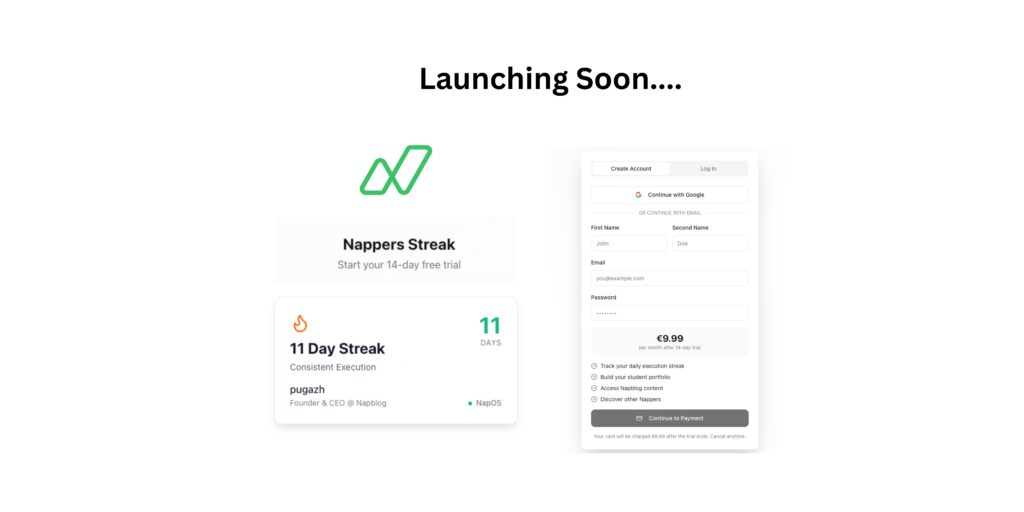
Launch soon. Nappers Streak @ €9.99/month
Blog

Launch soon. Nappers Streak @ €9.99/month

Consistency That Earns Opportunity — Native to NapOS In the modern career economy, effort alone is invisible. Intentions do not compound. Credentials do not differentiate. What compounds—and what increasingly earns opportunity—is visible, sustained execution. Today, we are announcing Nappers Streak, a core, OS-native capability inside NapOS designed to make professional consistency measurable, visible, and compounding. This is not a gimmick.This is not a motivational counter.This is not another habit app repackaged for careers. Nappers Streak is a professional momentum system—inspired by the psychological pull of the Snapchat streak, but engineered for outcomes that matter: interviews, jobs, clients, credibility, and trust. NapOS is built on one principle: Consistency earns opportunity. Nappers Streak operationalizes that principle at the operating-system level. Why Streaks Matter (and Why Most Career Tools Ignore Them) Streaks work because they exploit a simple truth of human psychology:loss aversion beats motivation. People do not want to break a streak—not because the number matters, but because the streak represents identity continuity. “I am someone who shows up.” Snapchat understood this early. The streak itself is meaningless. The behavioral loop is not. Careers, however, have been built on the opposite assumption: This mismatch is why capable people stagnate while consistent people advance. Nappers Streak exists to close that gap. What Nappers Streak Actually Counts Let us be explicit. Nappers Streak is not a vanity counter.It does not reward noise.It does not inflate activity. It counts only what materially moves you toward a defined professional goal. Inside NapOS, every user operates within: The streak increments only when execution meets quality thresholds: This is why the streak means something. A 30-day streak inside NapOS is not “I was busy for 30 days.”It is “I executed professionally, with evidence, for 30 consecutive days.” That difference is everything. OS-Native by Design, Not an Add-On Most productivity tools fail because they sit outside how people work. NapOS takes a different approach. Nappers Streak is OS-native: This matters. By building Nappers Streak into the operating system itself, consistency becomes: You do not “open” motivation.You live inside a system that assumes execution. The Aesthetic of Professional Momentum NapOS is intentionally designed as a fusion of Mac and Windows philosophies: The result is an environment that feels: Nappers Streak inherits this philosophy. No gamified explosions.No dopamine-hacking noise.No artificial urgency. Just a clean signal: This aesthetic restraint is deliberate.Professionals do not need hype—they need clarity and momentum. AI-Enabled, But Human-Accountable NapOS includes AI intelligence, but not in the way most platforms advertise it. AI does not replace responsibility.AI reinforces accountability. Within Nappers Streak, intelligence is used to: Crucially: The AI does not “do the work.”It reflects your behavior back to you without excuses. That reflection is often enough to correct course. Founder Leading From the Front Systems fail when leaders do not live inside them. NapOS is different. The founder is publicly streaking.Publicly tracking.Publicly attaching evidence.Publicly compounding execution. This is not marketing theater.It is system validation. When users see leadership executing daily: Nappers Streak is not a promise of what NapOS will do.It is evidence of what NapOS already enforces. Consistency is not aspirational here.It is operational. From Streak to Signal: Why Opportunity Responds Recruiters, clients, and founders are not irrational.They are risk-minimizers. Given two candidates with similar skills: The decision is trivial. Consistency signals: Nappers Streak turns invisible effort into legible trust. Over time, users report: Not because the streak number is impressive—but because the behavior behind it is undeniable. €9.99 Is Not the Product. Accountability Is. NapOS pricing is intentionally simple: €9.99 per month. This is not SaaS pricing logic.This is behavioral economics. At €9.99: NapOS becomes a systematic accountability partner.Not a tool you install.Not a subscription you forget. You do not pay for features.You pay to stay consistent when motivation fades. That is the actual value. Ranking by Execution, Not Credentials Traditional platforms rank by: NapOS ranks by execution density: This is uncomfortable for some.It is liberating for others. Because it means: Nappers Streak is the backbone of this ranking system.Without it, the signal collapses. Consistency as a Career Philosophy NapOS is not a feature bundle.It is a philosophy encoded into software. The philosophy is simple: Nappers Streak is the behavioral anchor that makes this philosophy unavoidable. Break the streak, and you feel it.Maintain it, and opportunity starts to lean toward you. Not magically.Not immediately.But predictably. The Long Game Nappers Streak is launching as a core NapOS capability.What follows will deepen—not dilute—the principle: But the foundation will not change. No shortcuts.No hacks.No fake momentum. Just a system that quietly rewards those who show up. Closing Careers are not built in bursts.They are built in streaks. NapOS exists to make that truth operational.Nappers Streak exists to make it unavoidable. Consistency is no longer a personality trait.It is now infrastructure—inside Napblog Limited’s NapOS. Consistency = Earned Opportunity.

The Discipline Advantage: How Consistency Earns Respect & Opportunities?
Blog

The Professional Discipline Advantage: How Consistency Earns Respect & Opportunities?

There is a pattern most people miss. Opportunities do not usually go to the loudest, the most credentialed, or the most talented. They go—quietly and repeatedly—to the most consistent. Not consistency as motivation.Not consistency as hype.But consistency as visible execution over time. What follows is not a campaign announcement.It is not a product reveal.It is not a launch post. It is an explanation of outcomes—and why those outcomes compound faster than most people expect. The Snowball Nobody Sees Rolling Most professionals treat effort as a private activity and results as a rare announcement. That approach is backward. When effort becomes visible, and visibility becomes predictable, something interesting happens in human psychology: This is not virality.This is not personal branding theater. This is trust accumulation through repetition. Like a Snapchat streak—not for entertainment, but for career outcomes. Why Consistency Triggers Belief (Not Sympathy) Human decision-making is biased in one critical way: We reward discipline because discipline signals future reliability. Recruiters, founders, hiring managers, and clients rarely ask: “Is this person perfect?” They ask instead: “Will this person show up again tomorrow?” Visible consistency answers that question without words. When someone posts execution updates regularly—real work, real outputs, real learning—observers subconsciously conclude: Belief forms before conversations begin. The Mammoth Effect of Repeated Effort One post is ignored.Three posts are noticed.Ten posts are remembered.Thirty posts change how people treat you. This is the mammoth effect: Small, repeated actions → disproportionate perceived weight. Over time, something measurable happens: Not because you asked. Because you demonstrated discipline publicly. Why Outcomes Matter More Than Explanations People do not need to understand your system to respect your results. In fact, mystery increases credibility. When others cannot clearly articulate how you are progressing—but can clearly see that you are progressing—the effect is stronger: This is why the most effective execution systems are felt before they are explained. The signal precedes the story. From Effort to Interviews, Jobs, Internships, and Clients What changes when consistency becomes non-negotiable? This is not luck. This is career gravity created through repeated execution. The Respect Multiplier Something subtle but powerful emerges after sustained consistency: Respect. Not the loud kind.Not the performative kind. The quiet respect given to people who: Disciplined people are trusted with responsibility.Trusted people are offered opportunities. The loop reinforces itself. This Is Not About Posting. It Is About Becoming Inevitable. Posting is just the surface. What actually compounds is: When these combine, the market responds. Not immediately.Not predictably.But decisively. Final Thought You do not need to announce what you are building for people to feel its impact. When consistency becomes visible, outcomes speak first. And once outcomes speak often enough, opportunities stop asking who you are—they start assuming you belong. —Built within the Napblog Limited ecosystemFocused on outcomes, not noise