Napblog

January 17, 2026

SIOS From understanding grants and visas to managing accommodation, employment, and cost of living, access to clear, reliable, and timely information is critical.
SIOS - Students Ireland OS

SIOS Newsletter: Information Support for Students in Ireland

Studying in Ireland offers world-class education, cultural richness, and global career exposure. However, for both domestic and international students, navigating the Irish education and living ecosystem can be complex. From understanding grants and visas to managing accommodation, employment, and cost of living, access to clear, reliable, and timely information is critical. At Students Ireland OS (SIOS), our mission is to act as a central information support system, ensuring students are not left navigating fragmented or outdated guidance. This newsletter outlines the key information pillars every student in Ireland needs, where to find trusted resources, and how SIOS supports students throughout their academic journey. 1. Financial Information Support: Costs, Grants, and Budgeting One of the most common challenges students face in Ireland is financial planning, particularly with rising living costs. Key Areas of Support Trusted Information Sources SIOS Perspective SIOS simplifies financial information by breaking down eligibility criteria, deadlines, and common mistakes, helping students plan realistically and avoid last-minute financial stress. 2. Visa and Immigration Information Support (International Students) For international students, immigration compliance is non-negotiable. Misinformation can lead to serious legal consequences. Core Topics Students Must Understand Authoritative Sources SIOS Perspective SIOS acts as an early-warning and clarity system, translating immigration rules into student-friendly guidance and highlighting deadlines, compliance risks, and safe pathways. 3. Accommodation Information Support: Navigating a Housing Crisis Accommodation remains one of the most pressing challenges for students, particularly in Dublin. What Students Need to Know Key Information Channels SIOS Perspective Rather than offering listings, SIOS focuses on education and protection—helping students identify red flags, understand lease terms, and plan accommodation searches early. 4. Academic and Course Information Support Choosing the right course and institution directly affects employability, satisfaction, and long-term outcomes. Essential Academic Information Reliable Sources SIOS Perspective SIOS encourages students to research beyond marketing, asking the right questions before enrolment and understanding how academic choices align with career goals. 5. Employment and Work Rights Information Most students in Ireland work part-time, but many are unaware of their rights and obligations. Key Topics Trusted Sources SIOS Perspective SIOS bridges the gap between employment law and student reality, ensuring students understand contracts, avoid exploitation, and plan work strategically. 6. Health, Wellbeing, and Support Services Academic success is closely tied to physical and mental wellbeing. Information Students Need Key Providers SIOS Perspective SIOS normalises help-seeking by clearly mapping where to go, when, and how, especially for international students unfamiliar with the Irish health system. 7. Student Life, Rights, and Integration Beyond academics, students must understand their rights, responsibilities, and opportunities within Irish society. Areas of Support Core Organisations SIOS Perspective SIOS positions students not just as learners, but as active participants in Irish civic and campus life. Conclusion: SIOS as a Central Information Anchor Information overload is as harmful as information scarcity. Students in Ireland do not lack resources—but they often lack clarity, structure, and confidence in using them. SIOS exists to: By strengthening information support across finance, immigration, accommodation, academics, employment, and wellbeing, SIOS contributes to a more equitable, transparent, and student-centred experience in Ireland. Informed students make stronger decisions—and stronger decisions lead to better outcomes. That is the SIOS commitment.
The UK homeschooling landscape offers a powerful set of inspirations, not because it is rigid, but because it blends structure with freedom.
HOS - Homeschooling OS

Homeschooling OS: UK‑Inspired Pathways for Natural, Future‑Ready Learning

Across the United Kingdom, homeschooling—more accurately referred to as home education—has moved from the margins to the mainstream. What was once perceived as an alternative for a small group of families has evolved into a thoughtful, values‑driven educational movement. Parents are not merely withdrawing children from traditional schools; they are actively designing learning ecosystems that reflect their children’s needs, interests, pace, and future realities. Homeschooling OS is built on this premise: education should function like an operating system—adaptive, modular, resilient, and human‑centred. The UK homeschooling landscape offers a powerful set of inspirations, not because it is rigid, but because it blends structure with freedom. It demonstrates how national standards, world‑class public resources, and community trust can coexist with personalised learning. This article explores how Homeschooling OS can draw inspiration from UK homeschooling resources and philosophy to create a natural, inspiring, and future‑ready learning experience for families worldwide. Understanding the UK Home Education Mindset In the UK, parents are legally responsible for ensuring that their child receives a “suitable education”, but they are not required to follow the National Curriculum. This single distinction has shaped the UK homeschooling mindset profoundly. Instead of asking, “How do I replicate school at home?”, UK families often ask: This mindset aligns directly with Homeschooling OS. Education becomes: The result is learning that feels natural rather than forced. Public Knowledge as a Shared Asset One of the UK’s greatest contributions to global homeschooling is its commitment to free, high‑quality public learning resources. These resources were originally built for schools, but they have become foundational tools for home educators. This principle—public knowledge as shared infrastructure—is central to Homeschooling OS. Learning Without Paywalls UK homeschooling families routinely combine: The emphasis is not on consumption, but on application. Children might watch a short lesson on fractions, then bake bread. They might study persuasive writing, then draft a letter to their local council. Learning moves seamlessly between screen, paper, conversation, and life. Homeschooling OS adopts this same philosophy: content is a starting point, not the destination. Structure Without Rigidity A common misconception is that homeschooling lacks structure. In practice, UK home education demonstrates a different kind of structure—flexible scaffolding. Parents often use national benchmarks (such as Key Stages or GCSE outcomes) not as daily constraints, but as long‑term reference points. This allows families to: Homeschooling OS formalises this approach by separating: This separation is critical for natural learning. Early Years: Learning Through Living UK home education in the early years is deeply influenced by play‑based and experiential philosophies. Rather than formal lessons, learning emerges from: Children are not rushed into abstraction. Literacy grows from stories. Numeracy grows from patterns and play. Confidence grows from being trusted. Homeschooling OS recognises early childhood as the foundation layer of the operating system. If curiosity, safety, and self‑belief are established early, everything built later is stronger. Primary Years: Curiosity Meets Competence As children grow, UK homeschooling families often introduce more intentional learning—without abandoning curiosity. Typical characteristics include: Parents act less like teachers and more like learning architects—selecting resources, asking questions, and observing patterns. Homeschooling OS encodes this role explicitly. Parents are not expected to “know everything.” They are expected to: Secondary Years: Ownership and Direction One of the most powerful lessons from UK homeschooling emerges during the secondary years. Contrary to common fears, many home‑educated teenagers develop exceptional independence. Why? Because they have been practicing ownership for years. UK families often blend: Learning becomes purposeful. Teenagers understand why they are studying a subject and how it connects to their future. Homeschooling OS mirrors this by shifting from parent‑led to learner‑led systems over time. Autonomy is not granted suddenly; it is earned gradually. Assessment Without Anxiety The UK system is known for formal examinations, yet UK homeschoolers demonstrate that assessment does not have to dominate learning. Many families: Assessment becomes a tool, not an identity. Homeschooling OS treats assessment as diagnostic data—useful for calibration, never for labelling. Community as Infrastructure UK homeschooling thrives not in isolation, but in networks: Children interact with a wider range of ages and adults than they would in a classroom. Socialisation becomes authentic, not artificial. Homeschooling OS integrates community as a core module, not an optional add‑on. Learning is social by design. Inclusion, SEND, and Human Dignity A significant number of UK families choose homeschooling because traditional systems failed to support their children—particularly those with special educational needs or emotional challenges. Home education allows for: Homeschooling OS is grounded in the same belief: education should adapt to the child, not the child to the system. Preparing for an Uncertain Future The future of work, citizenship, and identity is uncertain. UK homeschooling families increasingly prioritise: These are not taught as separate subjects. They are woven into everyday learning. Homeschooling OS is explicitly future‑oriented. It is designed not to optimise for exams alone, but for adaptability, resilience, and purpose. Homeschooling OS: From Inspiration to Implementation Drawing from the UK experience, Homeschooling OS stands on five core principles: This is not anti‑school. It is post‑industrial education—designed for a world that values creativity, empathy, and systems thinking. Conclusion: Education as a Living System The UK homeschooling movement teaches us something profound: when families are trusted, supported, and resourced, education becomes more human. Homeschooling OS exists to scale that trust globally. It is not a curriculum. It is not a platform alone. It is a philosophy translated into systems—a living operating system for learning that grows with the child, adapts to the world, and honours the natural way humans learn. The future of education is not louder, faster, or more standardised. It is quieter, deeper, and more intentional. And it is already being built—one home, one child, one learning journey at a time.

a centralized, enforceable control layer that enables organizations to deploy AI systems while remaining compliant with the General Data Protection Regulation (GDPR) and the EU Artificial Intelligence Act (EU AI Act).
AIEOS - AI Europe OS

The AI Europe GDPR Gateway: Europe’s Control Layer for Lawful, Trusted, and Scalable AI

Executive Summary As artificial intelligence becomes embedded into every layer of European business, the regulatory environment governing its use has reached a new level of maturity and enforceability. The AI Europe GDPR Gateway represents a necessary architectural and governance evolution: a centralized, enforceable control layer that enables organizations to deploy AI systems while remaining compliant with the General Data Protection Regulation (GDPR) and the EU Artificial Intelligence Act (EU AI Act). For AI Europe OS (AIEOS), the GDPR Gateway is not a product category alone—it is an operating principle. It defines how AI systems interact with personal data, how accountability is enforced, and how European values such as privacy, proportionality, and human oversight are preserved at scale. This newsletter provides a strategic, technical, and regulatory deep dive into the AI Europe GDPR Gateway: why it exists, how it works, and why it is rapidly becoming a non-negotiable component of AI architectures operating in or serving the European Union. 1. Europe’s AI Reality: Regulation as Infrastructure Europe has made a deliberate choice: AI innovation must coexist with fundamental rights. Unlike other jurisdictions that rely on voluntary frameworks or post-hoc enforcement, the EU has embedded AI governance directly into binding law. Together, they create a dual compliance obligation that cannot be addressed through policy documents alone. Compliance must be technical, automated, provable, and continuous. This is where the AI Europe GDPR Gateway emerges—not as middleware, but as regulatory infrastructure. 2. What Is an AI Europe GDPR Gateway? An AI Europe GDPR Gateway is a centralized control plane that sits between: Its function is to mediate every AI interaction involving personal or regulated data, ensuring that no request, inference, training action, or output violates European data protection or AI governance rules. In practice, it functions as: Without such a gateway, organizations rely on fragmented controls, manual compliance, and trust assumptions—none of which satisfy European regulators. 3. Why Traditional AI Architectures Fail Under GDPR Most AI stacks were designed for speed, scale, and experimentation—not legal accountability. As a result, they exhibit systemic weaknesses in a European context: 3.1 Uncontrolled Data Propagation AI prompts, embeddings, logs, and fine-tuning datasets frequently contain personal data that is: 3.2 Lack of Purpose Limitation GDPR requires that data be used only for explicitly defined purposes. AI systems, by default, optimize for reuse and generalization—often violating this principle. 3.3 Inadequate Data Subject Rights Enforcement Rights such as access, rectification, erasure, and objection cannot be enforced if organizations cannot trace: 3.4 No AI-Specific Accountability Layer The EU AI Act introduces obligations such as: Traditional MLOps platforms do not natively support these requirements. 4. The Gateway Model: How It Works The AI Europe GDPR Gateway operates across five functional layers: 4.1 Data Routing and Isolation All AI-related data flows—prompts, responses, embeddings, training data—are routed through the gateway. This enables: 4.2 Identity, Authentication, and Authorization Using zero-trust principles, every request is evaluated based on: 4.3 Policy Enforcement Engine This is the core compliance layer. It enforces: Requests that violate policy are blocked or modified in real time. 4.4 Monitoring, Logging, and Traceability Every AI interaction is logged with: These logs form the basis for: 4.5 Lifecycle and Retention Control The gateway governs: This ensures that AI systems do not silently accumulate regulatory risk over time. 5. Zero-Trust AI: A European Necessity Zero-trust security—never trust, always verify—is foundational to the GDPR Gateway model. In an AI context, zero-trust means: European regulators increasingly view uncontrolled AI access as a systemic risk, particularly in sectors such as healthcare, finance, HR, and public services. The GDPR Gateway operationalizes zero-trust for AI by making every data interaction explicit, authorized, and auditable. 6. Alignment with the EU AI Act The EU AI Act introduces a risk-based classification system: An AI Europe GDPR Gateway enables organizations to: Without a gateway, these obligations become manual, error-prone, and economically unsustainable. 7. European Market Implications 7.1 For Startups Startups that embed a GDPR Gateway approach early gain: 7.2 For Enterprises Large organizations use gateways to: 7.3 For Public Sector and Regulated Industries Gateways enable lawful AI deployment in: These sectors are explicitly targeted by both GDPR enforcement authorities and AI Act supervisors. 8. The Strategic Role of AI Europe OS (AIEOS) AI Europe OS positions the GDPR Gateway as a core operating layer, not an optional add-on. From an AIEOS perspective, the gateway: It reflects a broader shift: compliance is no longer a constraint—it is a competitive differentiator in Europe. 9. Key Takeaways for Decision-Makers Conclusion: From Regulation to Resilience The AI Europe GDPR Gateway represents a maturation of the European AI ecosystem. It transforms regulatory obligations into architectural clarity, operational discipline, and market trust. For AI Europe OS, this gateway is not merely about avoiding fines or satisfying auditors. It is about building an AI economy that is: In the European context, there is no sustainable AI without governance—and no governance without infrastructure. The AI Europe GDPR Gateway is that infrastructure.

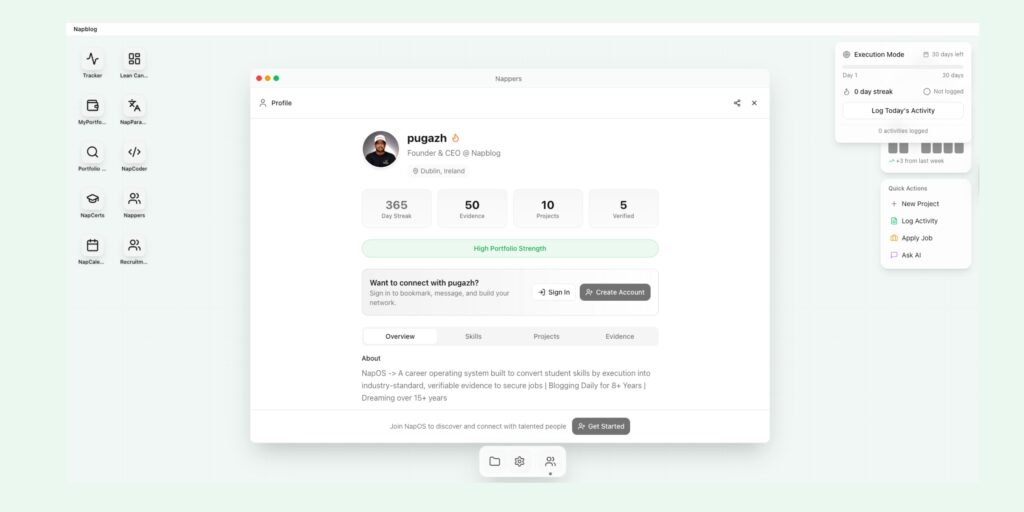
NapOS Public Profile Links - Nap OS Napblog.com
Blog, NapOS

NapOS Public Profile Links. An Open Letter to Recruiters, Founders, and Ecosystem Builders

Hiring is broken—not because talent is scarce, but because trust is expensive.Resumes overclaim. Certificates inflate. LinkedIn profiles optimise for optics, not outcomes.Recruiters are forced to infer ability from proxies, while founders gamble time and capital on signals that decay the moment real work begins. NapOS changes the unit of trust. This article explains why a public, shareable NapOS profile link—built on execution streaks, verifiable evidence, and system-level attribution—is not a feature, but an ecosystem primitive for employability, hiring, and long-term credibility. This is not about replacing LinkedIn.This is about doing what LinkedIn was never architected to do. 1. The Core Problem: Employability Runs on Proof, Not Profiles Recruiters do not hire potential.They hire risk-adjusted confidence. Yet the modern hiring stack relies on: These artefacts answer what someone says they can do, not: NapOS begins with a hard truth: Employability is not a credential problem.It is an execution visibility problem. 2. Why a Public NapOS Profile Exists The NapOS public link is designed as a live execution ledger, not a marketing page. https://os.napblog.com/n/pugazh_70b5?ref=np_pcf1avwk It answers four questions recruiters silently ask but rarely get clarity on: A NapOS public profile is read-only, shareable, and signal-dense: Just execution, time-stamped and structured. 3. The Streak: Why Consistency Beats Talent Snapchat understood something hiring platforms ignored:Consistency is more predictive than intensity. NapOS adopts a streak-based execution model because: A 365-day execution streak is not a gamification trick.It is behavioural proof. To a recruiter, a streak communicates: This is not a badge.It is a trust accelerant. 4. Evidence > Claims: How NapOS Reframes Skills In NapOS, skills cannot exist without evidence. Every skill: This eliminates: Instead, recruiters see: This mirrors how founders evaluate co-founders—not through claims, but through work trails. 5. Attribution: The Missing Layer in Modern Portfolios Most portfolios fail at attribution: NapOS enforces attribution clarity: This is critical for: Recruiters stop guessing.Founders stop probing.The system speaks first. 6. Why This Is Not “Another Profile” LinkedIn is a network graph.NapOS is an execution graph. LinkedIn optimises for: NapOS optimises for: They serve different layers of the professional stack. NapOS does not replace LinkedIn.It completes it. 7. The Public Link as a Hiring Primitive A NapOS public link functions as: Recruiters gain: Founders gain: Most importantly, time is respected on both sides. 8. Systematic Distribution: Why Visibility Must Be Earned NapOS does not promote virality.It promotes earned visibility. Profiles gain relevance through: This flips the attention economy: Recruiters are not fed noise.They discover signal. 9. Ecosystem, Not a Feature This is where NapOS diverges fundamentally. The public profile is not standalone.It is embedded within the Napblog Limited ecosystem: Each layer reinforces the others. Remove one, the system weakens.Together, they form a trust infrastructure. 10. For Recruiters: A Direct Proposition NapOS asks recruiters to stop asking: Instead, ask: This changes interview dynamics: Hiring becomes calmer, faster, and fairer. 11. For Founders: Why This Matters at Scale Early teams fail not due to lack of intelligence, but lack of execution rhythm. NapOS profiles reveal: These are founder-grade signals. A founder does not need charisma.They need follow-through. NapOS makes follow-through visible before equity or salary discussions. 12. For Students and Early Talent: Dignity Through Proof NapOS is not anti-education.It is anti-ambiguity. Students gain: No more: Just work. Logged. Visible. Trusted. 13. Trust as Infrastructure, Not Opinion Most platforms treat trust as: NapOS treats trust as: This is infrastructure-level thinking. Trust is no longer requested.It is demonstrated. 14. What We Are Asking the Ecosystem To recruiters: To founders: To institutions: This is not a finished product.It is a living system. 15. The Long-Term Vision In ten years, résumés will look archaic.Static profiles will feel irresponsible. The world will ask: NapOS is being built for that future—now. Closing The NapOS public profile is not a branding exercise.It is a contract with reality. If you believe: Then engage. Critique. Pressure-test. The system improves only when serious people take it seriously. Execution leaves a trail.NapOS makes that trail impossible to ignore. —Napblog LimitedBuilding execution-first employability infrastructure

Nap OS - Workflows - Templates
NapOS

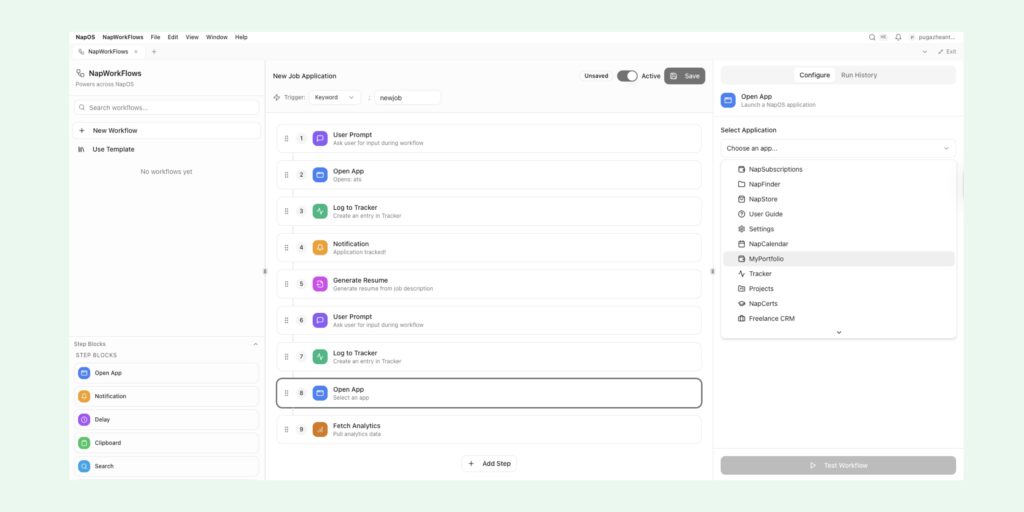
NapWorkflows — Turn Student Chaos Into Automated Progress

The Problem Students Don’t Realise They Have Students today are not short on tools. They are short on coordination. A typical student’s week looks like this: The result is not lack of effort — it is fragmentation. NapOS was designed to solve this at the operating-system level.And NapWorkflows is the automation engine that makes it real. NapWorkflows allows students to connect actions across NapOS apps and external systems, so work flows forward automatically — without relying on memory, discipline, or constant manual effort. This newsletter explains: What Is NapWorkflows? NapWorkflows is a native automation layer inside NapOS. It allows students to: Think of it as: “If this happens → then NapOS does everything else for me.” Unlike traditional automation tools, NapWorkflows is context-aware: Internal + External Automation (Why This Matters) NapWorkflows works at two levels: 1. Internal Automation (Native NapOS Apps) These apps share a common context, so actions flow cleanly. 2. External Automation (Webhooks) This means students can automate real-world systems, not just internal notes. 15 Student Automation Scenarios (With Template Outcomes) Each scenario below is something students already try to do manually — now converted into a NapWorkflows template. 1. New Job Application Workflow Trigger: Keyword: newjob Automated Flow: Outcome Template:“New Job Application — Fully Tracked” Impact:No application is ever untracked, forgotten, or undocumented again. 2. Daily Study Evidence Capture Trigger: Scheduled (daily) Automated Flow: Outcome Template:“Daily Learning Evidence” Impact:Learning turns into verifiable proof, not vague memory. 3. Portfolio Auto-Update After Work Trigger: Project progress update Automated Flow: Outcome Template:“Portfolio Sync — Project Update” Impact:Portfolios stay current without manual rewriting. 4. Recruiter Outreach Draft Generator Trigger: Keyword: outreach Automated Flow: Outcome Template:“Recruiter Outreach Draft” Impact:Students stop procrastinating outreach due to writing friction. 5. Interview Preparation Pack Trigger: Keyword: interview Automated Flow: Outcome Template:“Interview Prep Pack” Impact:Preparation becomes structured instead of rushed. 6. Follow-Up Reminder Automation Trigger: Time-based (X days after application) Automated Flow: Outcome Template:“Application Follow-Up System” Impact:Professional follow-ups without relying on memory. 7. Certification Progress Tracker Trigger: Certification activity update Automated Flow: Outcome Template:“Certification Evidence Tracker” Impact:Certifications become career signals, not PDFs lost in folders. 8. Weekly Execution Report Trigger: Weekly schedule Automated Flow: Outcome Template:“Weekly Execution Report” Impact:Students see momentum clearly — or absence of it. 9. Portfolio Health Check Trigger: Monthly schedule Automated Flow: Outcome Template:“Portfolio Health Snapshot” Impact:Portfolios stay interview-ready year-round. 10. Job Search Analytics Snapshot Trigger: Keyword: analytics Automated Flow: Outcome Template:“Job Search Analytics” Impact:Students understand what is working — and what is not. 11. Project Kick-Off Automation Trigger: Keyword: newproject Automated Flow: Outcome Template:“New Project Kick-Off” Impact:Projects start clean instead of chaotic. 12. Evidence Capture from Clipboard Trigger: Clipboard change Automated Flow: Outcome Template:“Instant Evidence Capture” Impact:Important proof never disappears again. 13. External Job Board Sync (Webhook) Trigger: Webhook from job form/API Automated Flow: Outcome Template:“External Job Sync” Impact:External actions still live inside NapOS. 14. Study → Portfolio Conversion Trigger: Study session completion Automated Flow: Outcome Template:“Learning to Portfolio Pipeline” Impact:Learning directly increases employability. 15. Monthly Career Review Trigger: Monthly schedule Automated Flow: Outcome Template:“Monthly Career Review” Impact:Students operate with clarity, not anxiety. Why Templates Matter Every workflow above is saved as a template. This means: NapWorkflows is not about automation for automation’s sake.It is about removing friction from progress. From Chaos to Systems Thinking Most students think success requires: NapOS takes a different view: Success requires fewer decisions and better systems. NapWorkflows transforms: Closing: This Is the NapOS Advantage NapWorkflows is not a feature.It is a behavioral upgrade. When students automate: NapOS does not ask students to work harder.It makes sure their work counts. More templates are coming.More integrations are coming.But the foundation is already here. NapWorkflows is how students turn daily actions into long-term advantage.