
When Aidan started freelancing, it was not part of a grand plan.
He was a final-year student in Ireland, doing small web and marketing gigs for local businesses—€300 here, €500 there. Enough to pay rent. Enough to stay independent. But not enough to scale, hire, or think long-term.
Like most students and early freelancers, Aidan had three silent problems:
- He had skills, but no structured business model
- He had clients, but no proof of execution depth
- He had heard about Irish government grants, but had no idea where to start or whether he even qualified
This is where NapblogOS entered the picture.
Step 1: Turning Freelance Chaos Into a Structured Portfolio
When Aidan joined NapblogOS through his university, the first thing that surprised him was this:
“The system did not ask for ideas. It asked for evidence.”
NapblogOS guided him through a structured execution workflow:
- Documenting real freelance projects
- Logging decisions, iterations, and outcomes
- Publishing work on a standardized portfolio domain
- Tracking traffic, leads, and real-world usage
What was once scattered freelance work became a system-verified execution portfolio.
Not a PDF.
Not a pitch deck.
But a living, measurable body of work.
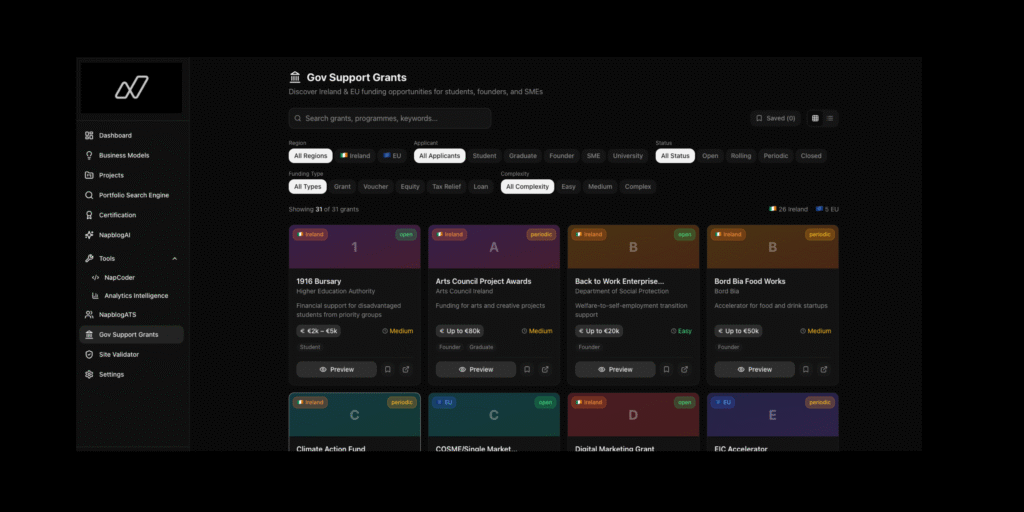
Step 2: Discovering the Right Irish Government Grant
Like many students, Aidan assumed grants were either:
- Too complex
- Only for “real startups”
- Or meant for someone else
Inside NapblogOS, the Gov Support Grants module changed that perception.
Instead of generic lists, the system filtered grants by:
- Student / graduate eligibility
- Founder stage
- Business readiness
- Complexity level
- Open vs periodic funding cycles
For the first time, Aidan could clearly see:
- Which grants he qualified for now
- Which grants required more validation
- What evidence was missing from his portfolio
Grants were no longer abstract. They were mapped directly to his execution level.
Step 3: Using Execution Data to Strengthen the Application
Rather than starting from a blank application form, Aidan used NapblogOS to extract:
- Proof of market activity
- Documented project milestones
- Revenue signals from freelance clients
- Clearly logged decision-making history
The grant application stopped feeling like “selling an idea” and started feeling like submitting evidence.
This was a turning point.
The system did not teach him how to “sound impressive.”
It helped him be verifiable.
Step 4: The Grant Was Approved — But the System Stayed
Aidan received his first Irish government grant.
But the most important part is what happened next.
NapblogOS did not disappear after funding.
Instead, it became:
- His execution dashboard
- His reporting system
- His portfolio validation engine
- His roadmap from freelancer to founder
The grant funded growth.
The system enforced discipline.
Step 5: From Solo Freelancer to Early-Stage Entrepreneur
Six months later:
- Aidan registered his company
- He hired his first collaborator
- He stopped chasing random gigs
- He began building a repeatable service business
Not because he “felt ready” —
But because the system showed that he was.
Why This Matters for Students
NapblogOS is not about teaching theory.
It is about:
- Turning student work into market evidence
- Making government grants accessible, not intimidating
- Replacing guesswork with execution signals
- Helping students graduate with proof, not promises
For many students, the gap between education and entrepreneurship is not talent.
It is structure.
NapblogOS exists to close that gap.
This is a mock story.
But the pathway is real.
And it is being built for the next generation of students, freelancers, and founders across Ireland and beyond.