Last updated: May 29, 2026
4 min read
The Moment You Notice Something Is Off
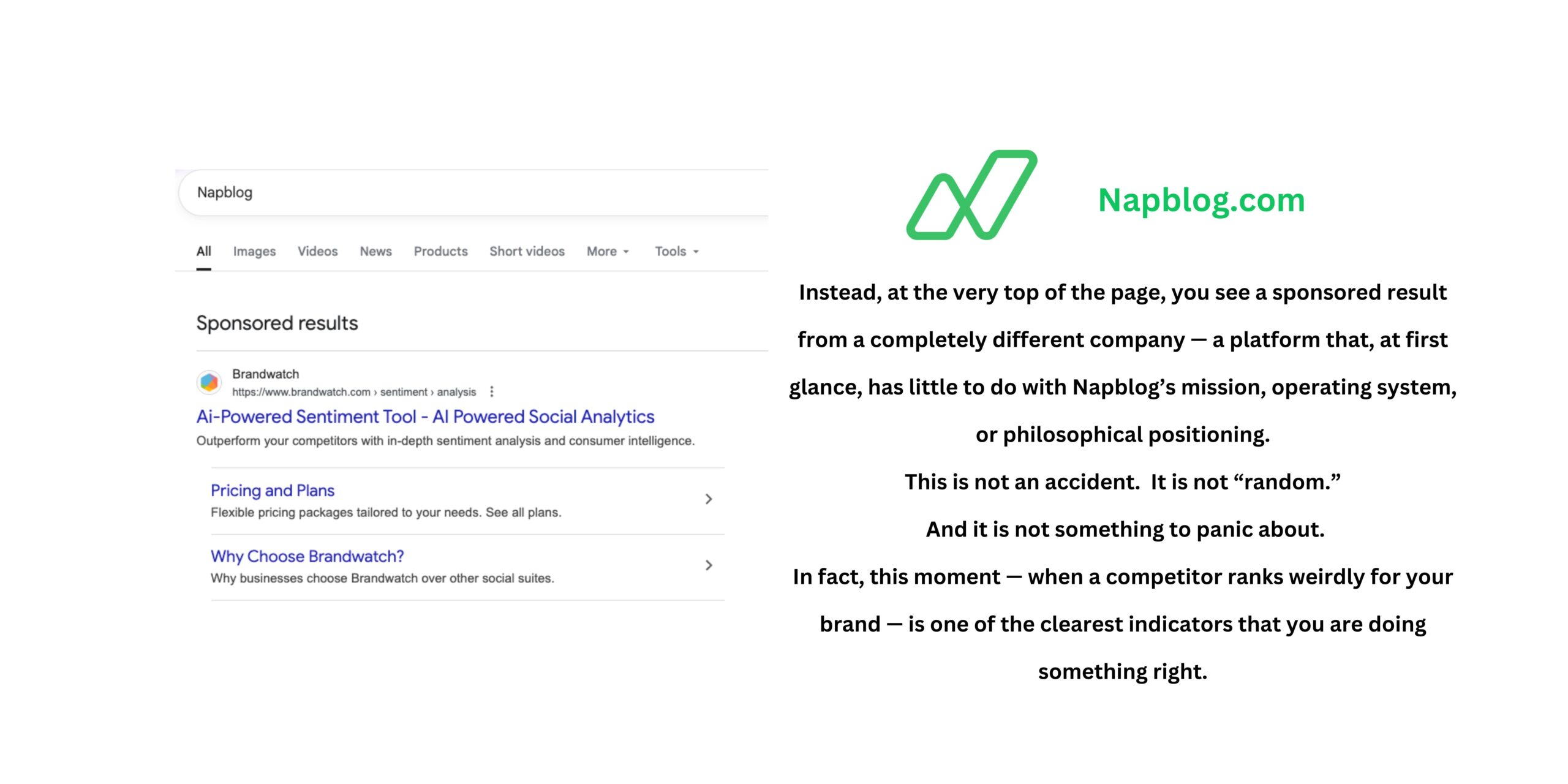
You search Napblog on Google.
You expect to see:
- Your homepage
- Your core product pages
- Your content ecosystem
- Your narrative
Instead, at the very top of the page, you see a sponsored result from a completely different company — a platform that, at first glance, has little to do with Napblog’s mission, operating system, or philosophical positioning.
This is not an accident.
It is not “random.”
And it is not something to panic about.
In fact, this moment — when a competitor ranks weirdly for your brand — is one of the clearest indicators that you are doing something right.
This article breaks down:
- Why this happens
- What it means strategically
- How Napblog should interpret it
- And how brand-level intelligence turns this into leverage, not loss
1. What “Weird Competitor Ranking” Actually Means
When a company appears for Napblog-branded searches, especially through paid placements, it usually signals one (or more) of the following:
- Brand keyword bidding (intent capture)
- Category confusion exploitation
- Algorithmic intent mapping
- Market validation behavior
This is not SEO failure.
This is brand gravity.
Competitors do not bid on brands that:
- Lack demand
- Lack clarity
- Lack commercial intent
- Lack future relevance
They bid on brands that convert attention into action.
2. Sponsored Results Are a Psychological Battlefield
Let’s be precise.
A sponsored result ranking above Napblog for “Napblog” is not trying to replace Napblog.
It is trying to intercept cognition.
Platforms like Brandwatch operate on a different axis:
- Social listening
- Sentiment analytics
- Enterprise monitoring
Napblog, by contrast, operates as:
- A thinking OS
- A contribution engine
- A human-centric operating system for meaning, not monitoring
So why show up there?
Because Google Ads does not optimize for truth — it optimizes for probability of conversion.
The ad system sees:
- A branded query
- A curious human
- A high-intent moment
And competitors try to borrow that moment.
3. This Is Not Competition — It’s Asymmetry
True competitors share:
- Customer worldview
- Problem framing
- Language
- Mental models
What you’re seeing instead is asymmetric competition.
Napblog is not a sentiment tool.
It is not a dashboard.
It is not a monitoring suite.
Yet monitoring companies appear because:
- Napblog users are thinkers
- Thinkers research deeply
- Deep researchers are valuable leads
This is not substitution.
It is adjacency exploitation.
4. Why Napblog Attracts Brand Bidding
There are four structural reasons Napblog attracts this behavior:
4.1 Napblog Signals “Uncommodified Intelligence”
Napblog content does not read like:
- Feature lists
- Pricing pages
- Sales funnels
It reads like thinking in public.
That attracts:
- Enterprise tools
- Analytics platforms
- Surveillance-adjacent software
- Compliance and monitoring vendors
They want Napblog’s audience, not Napblog’s product.
4.2 Napblog Queries Indicate High Cognitive Intent
People searching Napblog are not:
- Browsing casually
- Killing time
- Shopping impulsively
They are:
- Evaluating systems
- Comparing philosophies
- Seeking frameworks
- Looking for meaning, not metrics
Ad platforms reward this.
4.3 Brand Ambiguity Creates Auction Opportunity
Napblog is intentionally non-obvious.
That is a strength — but it creates a temporary vacuum:
- Algorithms attempt to “guess” category
- Competitors inject themselves into that guess
- Ads exploit semantic openness
This is normal during category creation phases.
4.4 Napblog Is Building a Category, Not Filling One
Category creators always experience:
- Brand hijacking
- Intent misclassification
- Paid adjacency pressure
This happened to:
- Notion
- Figma
- Stripe
- Substack
- Webflow
Napblog is early — which means cheap interception is still possible.
That window closes.
5. Why This Is Actually a Signal of Market Validation
Here’s the uncomfortable truth for competitors:
You don’t bid on brands you don’t respect.
Brand bidding is expensive, inefficient, and risky unless:
- The brand converts
- The brand attracts qualified thinkers
- The brand has long-term staying power
Napblog checks all three.
This is not theft.
This is recognition without permission.
6. The Real Risk Is Not Competitors — It’s Silence
The only dangerous scenario is:
- No ads
- No competitors
- No interception
- No confusion
That would mean:
- No demand
- No curiosity
- No threat perception
Napblog is past that stage.
7. What Napblog Should Do (Strategically, Not Emotionally)
7.1 Own the Narrative, Not the Auction
Do not outbid everyone blindly.
Instead:
- Clarify brand language
- Reinforce category definition
- Make Napblog unmistakable
When people land on Napblog, they should instantly feel:
“This is not what I thought — and that’s why it matters.”
7.2 Publish Against the Confusion
Use content to:
- Contrast tools vs thinking
- Monitoring vs meaning
- Data vs contribution
- Insight vs wisdom
Competitors rely on interruption.
Napblog wins through resonance.
7.3 Let Competitors Pay the Education Tax
Every ad bidding on Napblog:
- Increases brand legitimacy
- Trains the market
- Raises awareness
- Funds Google — not Napblog
But Napblog benefits for free.
This is asymmetric warfare.
And Napblog is winning quietly.
8. The Long Game: Why This Problem Solves Itself
As Napblog matures:
- Category clarity increases
- Branded search becomes navigational
- Ads lose relevance
- CPCs spike
- Competitors drop off
The only brands that suffer long-term brand bidding are:
- Weak brands
- Confusing brands
- Commodity brands
Napblog is none of these.
9. Reframing the Question Entirely
The real question is not:
“Why are they ranking for us?”
The real question is:
“What signal are we emitting that makes interception worth the cost?”
That answer is the strategy.
10. Final Thought: This Is the Cost of Being Early and Real
Napblog is not being copied yet.
It is being orbit-tested.
That means:
- You are visible
- You are valuable
- You are unresolved (in a good way)
Weird rankings are not noise.
They are market sonar pings.
And Napblog is loud enough now that others are listening.
Competitor visibility is a signal worth watching, not fearing. See how Napblog reads market signals on LinkedIn.