Last updated: May 29, 2026
5 min read
1. Introduction: When Your Own Name Becomes a Battleground
For most early-stage companies, the branded keyword phase is simple. You search your company name, and you own the page. No ads. No distractions. Just organic links you control.
Then something changes.
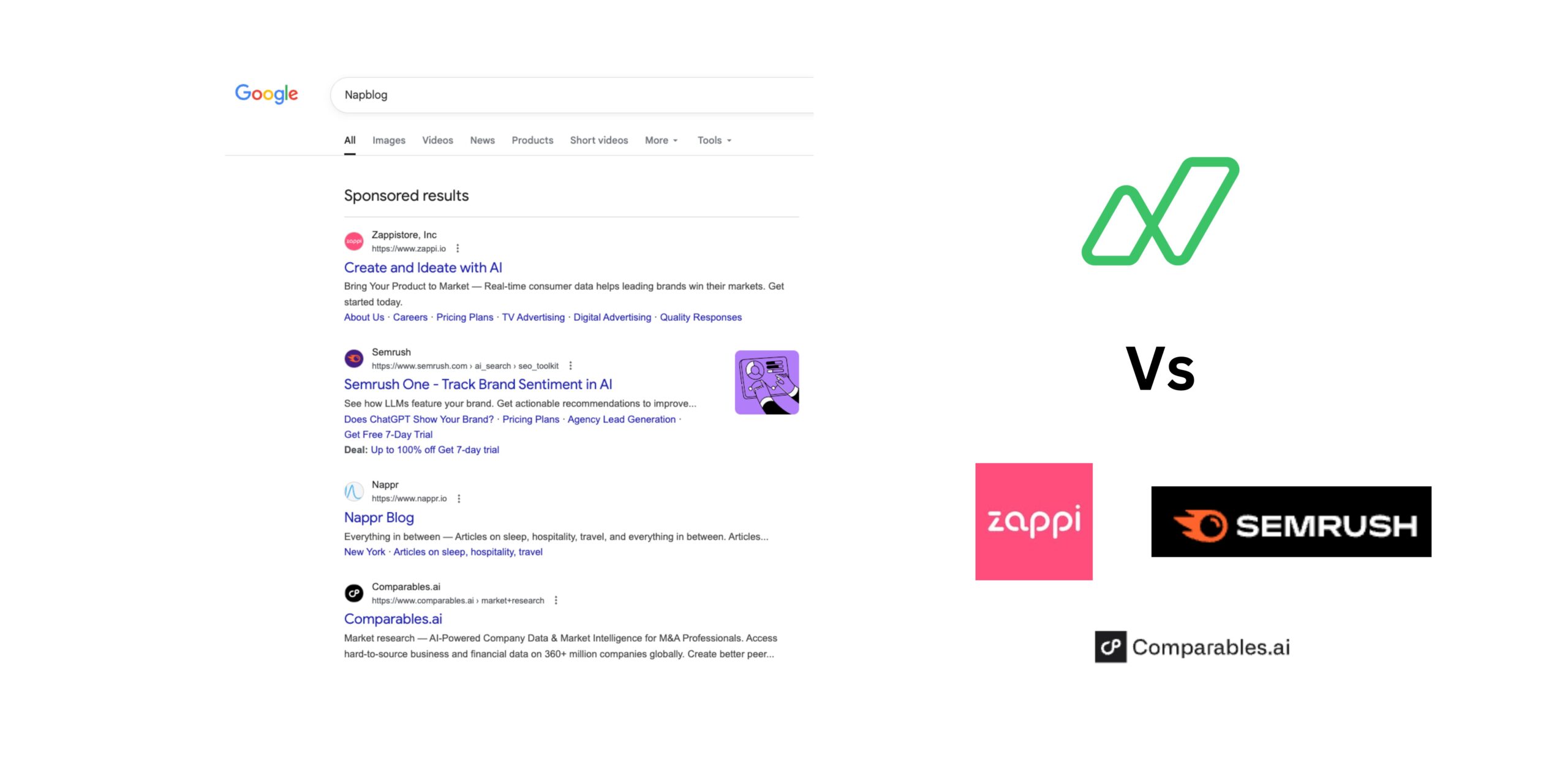
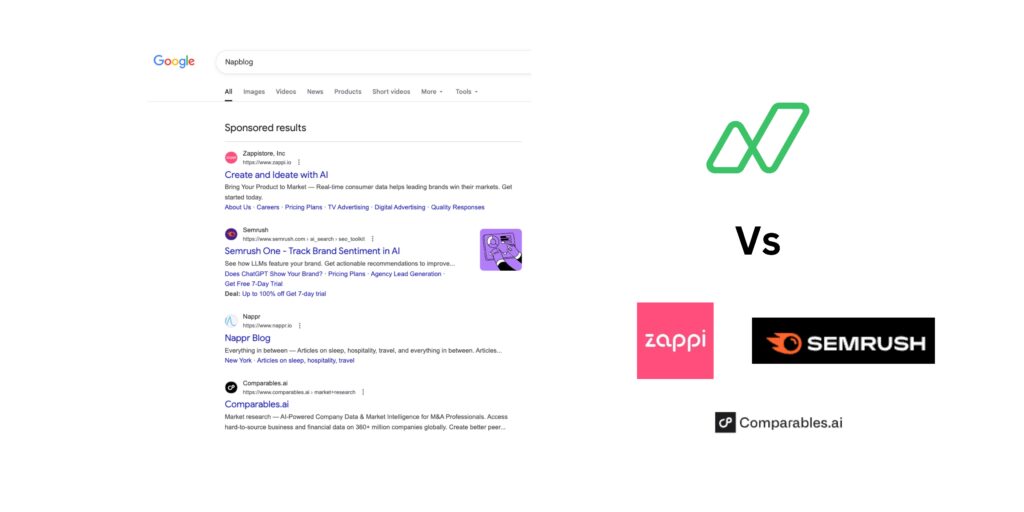
Suddenly, searching “Napblog” shows sponsored ads from unrelated SaaS platforms, market research tools, and enterprise software companies. None of them are Napblog. Yet they are paying to appear above or around Napblog’s own homepage.
This is not accidental.
This is not noise.
This is a signal.
This article examines why Google Ads competitors are bidding on the Napblog branded keyword, what it means for Napblog Limited as a company, and how this moment should be interpreted—not as a threat, but as confirmation of brand gravity.
2. Understanding Branded Keyword Conquesting
In Google Ads, bidding on another company’s brand name is known as brand conquesting.
Competitors (or adjacent platforms) intentionally target searches where:
- The user already has intent
- The user is searching for a specific solution
- The brand has enough awareness to justify ad spend
No serious company conquest-bids on unknown brands.
What this implies:
- Napblog has crossed the awareness threshold
- Searches for “Napblog” now signal commercial and strategic intent
- Google’s ad auction system considers “Napblog” a valuable query
That alone places Napblog in a very different category than most agencies or OS-style platforms.
3. Why Unrelated Platforms Appear on “Napblog” Searches
Looking at the sponsored results, several patterns emerge:
- Market research platforms
- AI-driven analytics tools
- Enterprise SaaS positioning tools
- Generic “AI for marketing” products
These companies are not competitors in the literal sense. They are intent hijackers.
Why Google allows this:
Google Ads optimizes for:
- Expected click-through rate
- Keyword semantic proximity
- Landing page relevance
- Historical conversion data
The system is not asking:
“Is this Napblog?”
It is asking:
“Is the user searching for something strategic, analytical, or execution-oriented?”
Napblog’s brand positioning—execution systems, operating systems, employability infrastructure—creates semantic overlap with high-value SaaS categories.
That overlap is enough.
4. Napblog’s Brand Has Moved from “Name” to “Intent”
This is the most important shift.
Early brands are labels.
Mature brands become verbs.
Advanced brands become intents.
When someone searches “Napblog”, Google no longer treats it as:
“A small company’s name”
It treats it as:
“A user looking for systems, execution, proof, and outcomes”
That is why platforms like Semrush or enterprise research tools feel justified bidding on it. They believe:
- The user might be comparison-shopping
- The user might be open to alternatives
- The user is high-value
This only happens when a brand signals problem-space ownership.
5. Why This Is Actually a Validation Moment for Napblog
From a strategic marketing lens, branded keyword competition appears only when three conditions are met:
- Search volume is consistent
- User intent is monetizable
- The brand is shaping a category
Napblog meets all three.
If Napblog were still perceived as:
- A generic blog
- A low-signal agency
- A content-only site
There would be zero ads.
The presence of competitors confirms:
- Napblog is influencing buyer psychology
- Napblog is educating the market
- Napblog is upstream of purchasing decisions
That is not accidental growth. That is structural brand impact.
6. The Google Ads Economics Behind “Napblog” Bidding
Let’s be precise.
Bidding on branded keywords has low Quality Score by default unless:
- The landing page strongly converts
- The brand term aligns with the advertiser’s core category
This means competitors are paying more per click for Napblog-related searches than they would for generic keywords.
No rational performance marketer does this unless:
- Lifetime value (LTV) is high
- Conversion probability is non-trivial
- The brand audience is strategically valuable
In simple terms:
Napblog’s audience is now worth stealing.
7. Why Napblog’s Organic Dominance Still Matters More Than Ads
Despite the presence of sponsored results, Napblog still owns:
- The homepage result
- Multiple internal sitelinks
- Knowledge panel associations
- Brand-aligned snippets
This matters because branded searches behave differently:
- Users skip ads
- Users scroll intentionally
- Users recognize the real brand
Google Ads may intercept attention, but organic brand trust still wins.
This is why Napblog’s long-term strategy of execution-based content, clear positioning, and SERP cleanliness is paying off.
8. The Strategic Risk of Ignoring Branded Keyword Defense
While this moment is validating, it is not something to ignore.
If Napblog does not actively defend its branded keyword:
- Competitors shape first impressions
- Narrative framing can drift
- Confusion can be introduced at scale
Even a low-budget branded search campaign:
- Reclaims top SERP real estate
- Controls messaging
- Protects conversion intent
This is not about fear.
This is about information hygiene.
9. What Napblog Should Do (and Not Do)
What Napblog SHOULD do:
- Run brand-only Google Ads with exact match
- Use copy that reinforces differentiation (execution OS, proof-based systems)
- Point ads to authoritative pages (Nap OS, About, Careers)
What Napblog should NOT do:
- Start conquesting unrelated brands
- Dilute messaging to compete with generic SaaS
- React emotionally to ads from larger platforms
Napblog’s strength is not scale—it is clarity.
10. The Bigger Picture: Brand Gravity vs Brand Noise
Many companies buy ads to create demand.
Napblog is now experiencing something rarer:
Others are buying ads because demand already exists.
This is brand gravity.
Brand gravity means:
- You are pulling attention without paying for it
- Others orbit your narrative
- Your name becomes a shortcut for a problem space
At this stage, the job is not louder marketing.
The job is sharper positioning.
11. Why This Moment Aligns Perfectly with Napblog’s Philosophy
Napblog was built on a core insight:
Execution matters more than claims.
Google Ads competitors bidding on “Napblog” is proof that:
- The market sees execution value
- The system Napblog advocates is resonating
- The conversation has moved beyond branding into infrastructure
This is exactly where Napblog intended to operate.
12. Final Perspective: This Is Not a Problem — It’s a Milestone
If no one ever bid on Napblog’s name, that would be a problem.
The fact that:
- Multiple platforms
- From different categories
- Are paying to appear on Napblog searches
Means Napblog has crossed an invisible but critical line.
It is no longer just a company.
It is a reference point.
The correct response is not panic.
It is composure, defense, and continued execution.
Because in the end, only the real system survives the search.