Last updated: May 29, 2026
6 min read
And What That Reveals About the Future of Higher Education
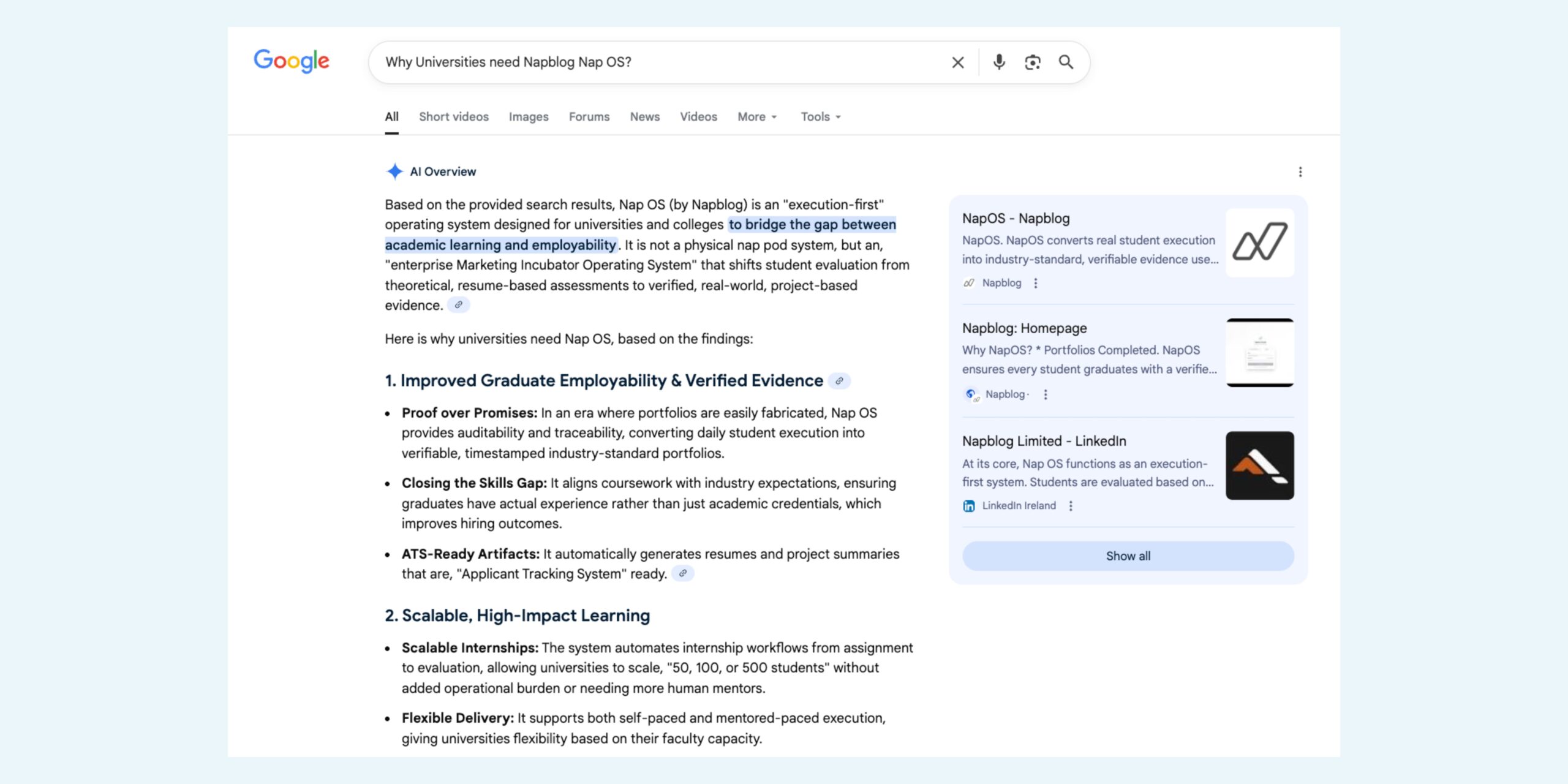
When Google answers a question, it is no longer simply retrieving links. Through AI Overview, Google is synthesizing institutional meaning from thousands of fragmented signals—web pages, documentation, professional discourse, hiring language, accreditation frameworks, and employer behavior.
So when Google responds to the query “Why Universities need Napblog Nap OS?”, what it reveals is not just a summary of Napblog’s messaging, but how the global information system itself understands the problem universities are facing—and where Nap OS fits structurally.
This article unpacks that understanding in depth.
1. Google Does Not See “Nap OS” as a Product — It Sees a Systemic Intervention
One of the most important signals in the AI Overview is what Google explicitly clarifies:
Nap OS is not a physical nap pod system.
This clarification matters more than it appears.
Google is actively disambiguating Nap OS from unrelated “nap” concepts (sleep pods, campus wellness, library napping areas). That means the system has already classified Nap OS into a different semantic cluster—one associated with:
- Employability
- Execution
- Institutional learning systems
- Career outcomes
- Verifiable evidence
In other words, Google understands Nap OS as infrastructure, not as a feature, tool, or service.
The phrase it uses—“execution-first operating system”—is especially revealing. That is not consumer language. It is systems language.
Google recognizes Nap OS as something that sits between:
- academic instruction, and
- labor market validation
This is the first key insight:
Google understands Nap OS as a missing layer in higher education’s architecture.
2. The Core Problem Google Identifies: The Evidence Gap
At the heart of the AI Overview is a single recurring theme:
Universities struggle to prove employability outcomes with credible, verifiable evidence.
Google highlights:
- fabricated portfolios
- resume-driven assessments
- theoretical grading
- unverifiable student claims
This is not Napblog’s language alone. This mirrors:
- recruiter complaints
- ATS filtering realities
- accreditation scrutiny
- employer distrust in credentials
Google’s synthesis frames Nap OS as solving a credibility crisis, not a skills crisis alone.
Proof Over Promises
When Google emphasizes auditability, traceability, and timestamped execution, it is effectively saying:
The modern hiring ecosystem no longer trusts static claims.
Degrees, resumes, certificates, and portfolios are too easy to manufacture. Google’s AI recognizes that the market is moving toward:
- process evidence
- execution logs
- decision trails
- iteration histories
Nap OS is framed as the system that captures work as it happens, not after the fact.
This is critical:
Nap OS is not seen as helping students describe work.
It is seen as helping institutions prove work.
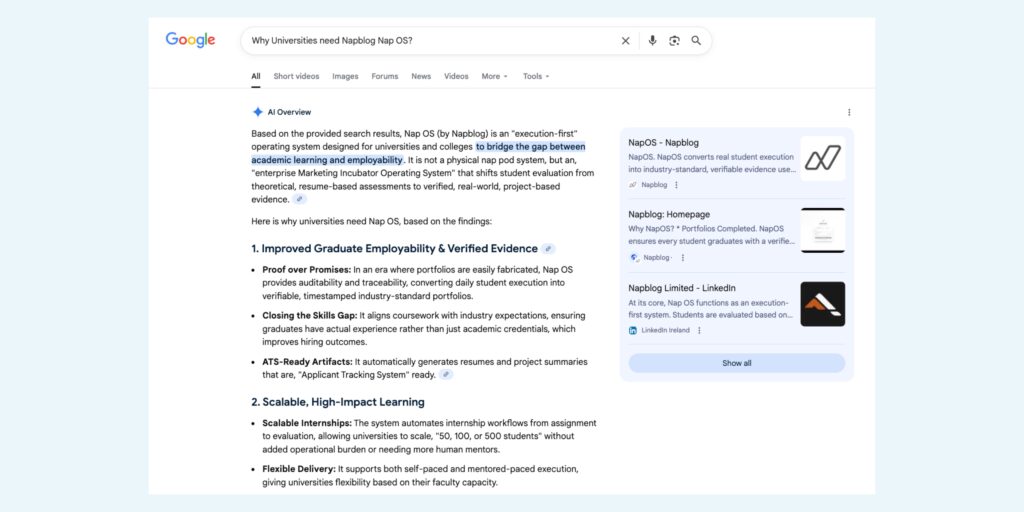
3. How Google Frames “Employability” Has Changed
Traditionally, employability in higher education meant:
- placement rates
- employer tie-ups
- internships as external programs
But Google’s AI Overview reframes employability as something embedded inside the learning system itself.
Nap OS is described as:
- aligning coursework with industry expectations
- converting daily execution into industry-standard artifacts
- generating ATS-ready outputs automatically
This tells us something profound about how Google understands modern education:
Employability is no longer downstream of education. It must be native to it.
Google implicitly acknowledges that:
- Career services are fragmented
- Internships don’t scale
- Faculty grading is subjective
- Student effort is poorly translated into hiring signals
Nap OS is positioned as a unifying layer that connects learning, execution, assessment, and employability into a single continuous system.
4. Scale Is Central to Google’s Reasoning
One of the strongest signals in the AI Overview is Google’s emphasis on scalability.
Google explicitly highlights:
- “50, 100, or 500 students”
- automation from assignment to evaluation
- reduced faculty workload
Why does this matter?
Because Google understands the institutional constraint universities face:
- Faculty cannot mentor infinitely
- Internships do not scale linearly
- Manual assessment breaks under volume
Google sees Nap OS not as a boutique solution for elite cohorts, but as infrastructure capable of operating at institutional scale.
This is crucial for universities because:
- Accreditation bodies care about cohorts, not individuals
- Funding decisions depend on aggregate outcomes
- Public accountability requires system-level reporting
Nap OS is framed as something that allows universities to scale rigor without scaling chaos.
5. Faculty Workload: The Silent Institutional Crisis
Notably, Google highlights reduced faculty workload.
This is significant because universities rarely market solutions around faculty constraints publicly—but internally, this is one of their biggest bottlenecks.
By mentioning:
- standardized evaluation
- reduced manual grading
- focus on high-impact mentorship
Google reveals that it understands:
- Faculty burnout
- Administrative overload
- The unsustainability of subjective assessment at scale
Nap OS is not framed as replacing educators. It is framed as absorbing the mechanical burden, allowing human expertise to be applied where it matters most.
This aligns with how Google increasingly understands AI-era systems:
Automation should remove friction, not judgment.
6. Institutional Strategy, Not Student Convenience
Another key aspect of Google’s framing is that it consistently speaks to the institution, not just to students.
Google highlights:
- accreditation data
- cohort analytics
- portfolio completion rates
- employability metrics
- funding justification
This tells us that Nap OS is understood as strategic infrastructure, not a student app.
Google sees Nap OS as something universities deploy to:
- defend their outcomes
- justify public and private funding
- demonstrate accountability
- modernize their institutional narrative
This is a crucial distinction. Many ed-tech tools are framed as student tools. Nap OS is framed as an operating system for the university itself.
7. Control and Sovereignty Matter in Google’s Model
Another subtle but important signal:
Universities install and run the system internally.
Google explicitly mentions control.
This is not accidental. In the post-cloud, post-vendor-lock-in era, institutions are increasingly wary of:
- data ownership loss
- opaque AI models
- external dependency
Google understands that universities want:
- sovereignty over student data
- internal governance
- compliance alignment
Nap OS is framed as a licensed, internally operated system, not a black-box SaaS siphoning institutional value.
This aligns Nap OS with enterprise infrastructure, not consumer software.
8. The AI Era: Why Verification Beats Generation
Perhaps the most forward-looking part of Google’s understanding appears in the section on AI and verification.
Google contrasts Nap OS with generic AI tools by emphasizing:
- execution trails
- decision analysis
- iteration verification
This is a critical insight.
In an era where AI can generate:
- essays
- code
- designs
- reports
the scarce value is no longer output. It is authentic execution.
Google implicitly recognizes that:
The future problem in education is not cheating — it is indistinguishability.
Nap OS is framed as a system that reconnects effort to outcome, ensuring that:
- work can be traced
- learning can be verified
- contribution can be attributed
This positions Nap OS not against AI, but as a governance layer for AI-era education.
9. Why Google’s Framing Is Strategically Powerful
The most important takeaway is this:
Google does not describe Nap OS as Napblog describes Nap OS.
It describes Nap OS as the system the ecosystem needs.
The AI Overview:
- abstracts away marketing
- removes founder narrative
- eliminates emotional language
What remains is a structural justification.
From Google’s perspective, universities need Nap OS because:
- current systems cannot prove value
- employability requires verification, not promises
- scale demands automation
- AI demands execution evidence
- institutions need defensible data
This is not aspirational language. It is diagnostic.
10. The Deeper Signal: Nap OS Fits Google’s World Model
Ultimately, Google’s AI Overview suggests something deeper:
Nap OS fits how Google already understands:
- hiring systems
- ATS filters
- verification economics
- institutional accountability
- post-credential education
That is why the answer is coherent, confident, and structured.
Google is not guessing.
It is recognizing alignment.
Conclusion: What This Means for Universities
When Google explains why universities need Napblog Nap OS, it is not acting as a promoter. It is acting as a systems interpreter.
Its answer reveals that higher education is undergoing a fundamental shift:
- from credentialing to verification
- from teaching to execution
- from outcomes claimed to outcomes proven
Nap OS is understood as the infrastructure that enables that shift.
Not because it is fashionable.
Not because it is innovative.
But because the old model no longer scales, verifies, or convinces.
And Google, more than any institution, understands when a system has reached that point.
Universities and students benefit when career platforms align with how search engines understand relevance. Follow Napblog on LinkedIn.