Last updated: May 29, 2026
5 min read
For decades, students have been told a simple story:
Study hard.
Get good grades.
Build a resume.
Then the real world will decide your future.
But something fundamental has changed.
Today’s job market does not suffer from a lack of degrees.
It suffers from a lack of verifiable execution.
Employers are no longer asking:
- Where did you study?
They are asking: - What can you actually do?
- What have you executed consistently?
- Can you prove it—without storytelling?
This is the gap Nap OS by Napblog was built to close.
Nap OS is not another learning app.
It is not a note-taking tool.
It is not a resume builder.
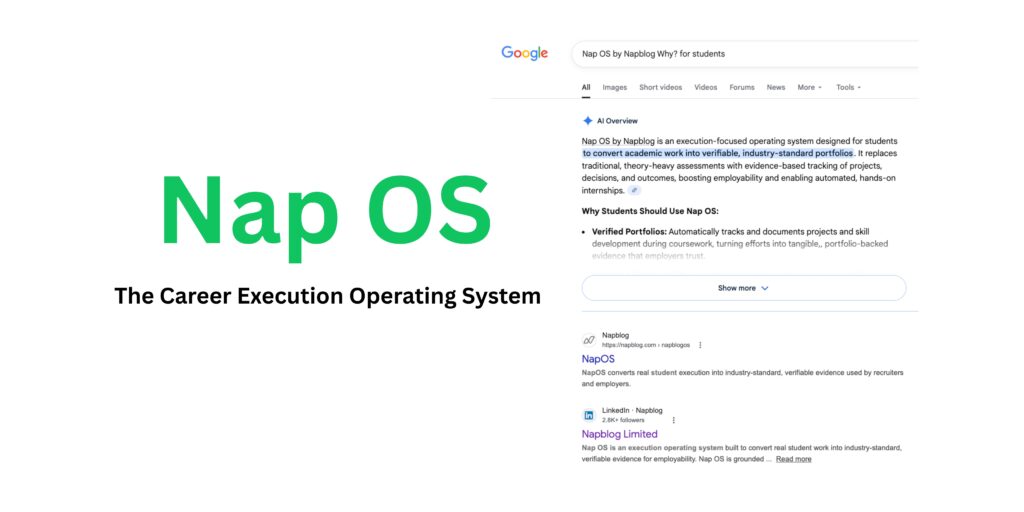
Nap OS is an execution operating system for students—designed to convert real academic and self-driven work into industry-standard, verifiable evidence that employers, recruiters, and institutions can trust.
The Core Problem Students Face (But Are Rarely Told About)
Most students believe effort equals opportunity.
In reality, untracked effort is invisible.
You may:
- Complete assignments
- Learn tools
- Practice skills
- Do internships
- Build side projects
But if that work:
- Is scattered across apps
- Lives in private folders
- Has no time-based proof
- Cannot be audited or replayed
Then, to the market, it does not exist.
Traditional systems rely on proxy signals:
- Grades
- Certificates
- Resume bullet points
- Interview performance
These signals are:
- Subjective
- Easy to inflate
- Poor predictors of real execution
Nap OS replaces proxy signals with direct evidence.
What Exactly Is Nap OS?
Nap OS is an execution-first operating system built by Napblog Limited, designed to help students:
- Track real work as it happens
- Convert daily execution into structured proof
- Build a living, evolving portfolio automatically
- Stay consistent without motivation hacks
- Present skills without self-promotion or storytelling
In simple terms:
Nap OS turns what you do into what you are known for.
Why Nap OS Is Built Specifically for Students
Students are not short on intelligence.
They are short on systems.
Nap OS acknowledges four realities of student life:
1. Students Learn While Doing (Not Before Doing)
Traditional education assumes:
- Learn theory → then apply later
Nap OS assumes:
- Execute first → learning emerges naturally
Every task logged inside Nap OS becomes:
- A learning artifact
- A skill signal
- A proof point
You do not “prepare” for the real world.
You operate inside it, even as a student.
2. Students Need Proof, Not Promises
When a recruiter sees:
“Skilled in marketing”
They ask:
- Compared to whom?
- For how long?
- Under what constraints?
- With what outcomes?
Nap OS answers these questions automatically through:
- Time-stamped execution
- Daily streaks
- Output logs
- Decision history
There is no exaggeration possible—only evidence.
3. Students Cannot Manage Fragmentation
Students today juggle:
- Google Docs
- Notion
- PDFs
- LMS portals
- Notes apps
- Cloud drives
Fragmentation kills consistency.
Nap OS acts as a single execution spine—a place where:
- All work is referenced
- All effort is tracked
- All progress compounds
You do not manage tools.
The system manages coherence.
4. Students Should Not Compete on Confidence
Not every capable student is:
- Articulate
- Loud
- Confident in interviews
Nap OS removes personality bias.
You are evaluated on:
- What you executed
- How consistently
- How you improved
- What you delivered
Execution speaks.
You do not have to.
How Nap OS Converts Academic Work into Industry Evidence
This is the breakthrough most students miss.
Assignments are not useless.
They are undocumented.
Nap OS allows students to:
- Log assignments as execution units
- Track time, iterations, and revisions
- Attach outputs, drafts, and decisions
- Show progression—not just final grades
A case study becomes:
- A skill demonstration
A project becomes:
- A portfolio artifact
A semester becomes:
- A verifiable execution timeline
This is why Nap OS portfolios are trusted—because they are generated by behavior, not claims.
From Resume Thinking to Portfolio Reality
Resumes are static.
Nap OS portfolios are alive.
A resume:
- Is written once
- Optimized for keywords
- Decays immediately
A Nap OS portfolio:
- Updates daily
- Reflects current ability
- Shows momentum
Recruiters do not ask:
“Tell me about yourself”
When they can see:
“Show me what you did—every day.”
Why Google AI Overview Recognizes Nap OS
Search engines now reward:
- First-hand experience
- Original execution
- Verifiable signals
Nap OS aligns with this shift because it:
- Produces structured, timestamped activity
- Reflects real human behavior
- Reduces fabricated narratives
Students using Nap OS are not just searchable.
They are indexable by evidence.
Nap OS and Automated Internships
Nap OS enables something new:
Internships without interviews.
Students can:
- Enter execution sprints
- Log daily work
- Submit real outputs
- Be evaluated objectively
No cold emails.
No resume filtering.
No bias.
Execution decides.
Mental Health and Cognitive Load (An Underrated Benefit)
Nap OS reduces:
- Decision fatigue
- Tool switching
- Motivation anxiety
Why?
Because:
- You only need to show up and execute
- Progress is visible
- Momentum is automatic
Consistency becomes a by-product, not a struggle.
What Using Nap OS Feels Like (From a Student’s Perspective)
Students often describe Nap OS as:
- “This is how it should have been”
- “I stopped worrying about proving myself”
- “My work finally counts”
- “I feel calm, not pressured”
Nap OS does not gamify you.
It grounds you.
The Long-Term Advantage for Students
Students who start early gain:
- A multi-year execution archive
- A compounding skill graph
- Proof that grows with them
- Optionality across careers
By graduation, they do not ask:
“Will I get hired?”
They ask:
“Which opportunity aligns with my execution history?”
AI, automation, and hiring systems are advancing fast.
Why Nap OS Is Not Optional Anymore
What survives is:
- Proof
- Consistency
- Real signals
Nap OS is not about beating AI.
It is about becoming legible in an automated world.
Final Thought:
Nap OS Is Not a Tool. It Is a Shift.
Nap OS changes the student question from:
“How do I impress?”
to
“How do I execute honestly and consistently?”
When you do that long enough,
opportunities stop being chased.
They start recognizing you.
A student-first system built for modern careers makes all the difference. Learn more on LinkedIn.