Nap OS

February 6, 2026

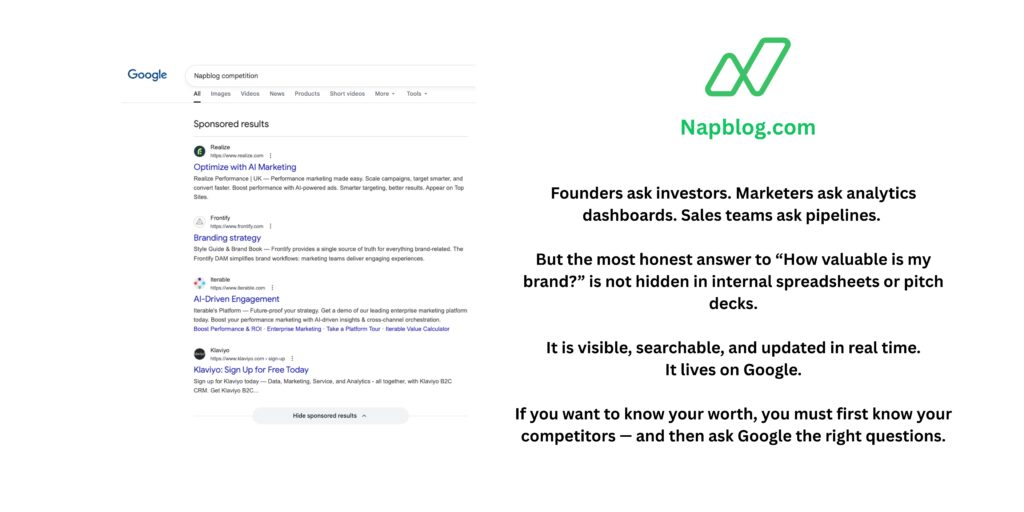
Napblog Google Ads competitors Ask Google
Blog

As a brand. If You Want to Know Your Worth, Know Your Competitors — and Ask Google Now

Your Brand’s Real Valuation Is Already Public Every brand wants to know its worth. Founders ask investors. Marketers ask analytics dashboards. Sales teams ask pipelines. But the most honest answer to “How valuable is my brand?” is not hidden in internal spreadsheets or pitch decks. It is visible, searchable, and updated in real time. It lives on Google. If you want to know your worth, you must first know your competitors — and then ask Google the right questions. Search engines are no longer just discovery platforms. They are real-time markets of intent, where competitors openly compete for attention, authority, and trust. Every keyword auction, sponsored result, and organic ranking is a signal. Every unfamiliar brand bidding on your name is a valuation event. Google does not guess your value.It prices it. This article explains why competitive search intelligence is the most underused valuation framework in modern marketing — and how brands like Napblog can use it to understand positioning, demand, and strategic worth. 1. Google as the World’s Largest Competitive Intelligence Engine Google is often treated as a traffic channel. That is a mistake. Google is: When someone types your brand name into Google, they are not just searching — they are expressing intent. That intent has monetary value, and competitors know it. That is why Google Ads exists. That is why competitors bid on branded keywords. That is why sponsored results appear even when the user already knows who they want. If no one is bidding against you, your perceived market value is low.If competitors are aggressively bidding on your name, your value is rising. Google does not lie. It reveals. 2. The Moment You See Competitors on Your Brand Keyword Search for your own brand. Not in incognito.Not as a logged-in admin.Search as a customer would. When you see: That is not noise. That is market validation. In the Napblog example, searching for brand-adjacent or branded queries surfaces companies offering: These companies are not appearing by accident. They are paying for visibility because they believe: That is your real worth — expressed in cost-per-click. 3. Competitors Reveal More Than You Ever Will Your own messaging is biased. Your website tells the story you want to tell.Your competitors tell the story the market believes. By analyzing who appears on your branded and near-branded searches, you learn: If competitors position themselves as: Then Google is grouping you in that ecosystem — regardless of how you describe yourself internally. Your worth is contextual.Your competitors define that context. 4. Brand Bidding Is Not Aggression — It’s Acknowledgment Many brands see competitors bidding on their name and react emotionally. “This is unfair.”“They’re stealing our traffic.”“We should block this.” That reaction misses the strategic signal. Brand bidding is acknowledgment. A competitor bidding on your brand keyword is publicly declaring: “Your brand has created demand we want to intercept.” That means you have already done the hard work — awareness, trust, positioning. Google Ads simply reveals who wants to monetize it. The stronger your brand becomes, the more competitors will appear. Silence is not safety.Silence is invisibility. 5. Asking Google the Right Questions Most brands ask Google the wrong questions. They ask: Strategic brands ask: These questions turn Google into a strategic intelligence layer, not just a channel. When you search your brand and see competitors, ask: Your worth is not just that they appear — it’s how they appear. 6. Organic Results Tell a Different Truth Paid results show who is willing to pay. Organic results show who has already won authority. If your brand name search returns: Then your brand has crossed an important threshold: interpretation. You are no longer just a company.You are a reference point. At that stage, your worth is not defined by traffic — it is defined by narrative control. If competitors are writing about your category better than you, they are quietly redefining your value in the market. 7. Search Visibility Is a Balance Sheet Traditional valuation looks backward. Search valuation looks forward. Every keyword represents: When competitors invest in those keywords, they are making forward-looking bets. If your brand attracts: Then your market value is increasing — whether or not your revenue has caught up yet. Search demand often leads revenue by months or years. Google shows who understands that. 8. Knowing Your Competitors Is Knowing Yourself Most brands maintain competitor lists that are outdated the moment they are created. Google updates them daily. Your real competitors are not always who you think they are. They are who: Sometimes they are direct.Often they are indirect.Sometimes they are substitutes. Understanding this ecosystem allows you to answer deeper questions: Your worth is tied to these answers. 9. Why Ignoring Google Is Strategic Blindness Brands that ignore search intelligence operate in the dark. They rely on: Meanwhile, competitors are actively: Google Ads is not just an acquisition tool.It is the fastest market research instrument ever created. Every impression is feedback.Every click is validation.Every competitor appearance is a signal. To ignore it is to outsource strategy to chance. 10. From Worth to Direction Knowing your worth is not about ego. It is about direction. When you understand: You gain clarity on where to invest next. You can decide: Search does not just tell you what you are worth. It tells you what you could become. Conclusion: Google Is the Most Honest Room You’ll Ever Enter Boardrooms are political.Analytics dashboards are selective.Pitch decks are aspirational. Google is honest. It shows: If you want to know your worth, do not ask internally. Know your competitors.Ask Google. And listen carefully to what it shows you — because the market already knows who you are becoming.

NapStrom — The Neural App of Nap OS You don’t need superpowers. You need to see how your brain already works.
NapOS

NapStrom — The Neural App of Nap OS You don’t need superpowers. You need to see how your brain already works.

You don’t need superpowers. You need to see how your brain already works. Modern careers don’t fail because of lack of talent.They fail because thinking is fragmented, effort is invisible, and actions don’t compound. Ideas live in one app.Tasks in another.Proof of work somewhere else.Learning is scattered.Reflection is postponed.Planning is reactive. Nap OS was built to fix this at the system level.And NapStrom is the neural core that makes it all coherent. NapStrom is not just another productivity app.It is the unified neural layer that interconnects all 50+ NapStore apps and lets you see, plan, recombine, and execute your career the way the brain actually works. If Nap OS is the operating system for long-term growth,NapStrom is the brain itself—firing, wiring, and evolving in front of you. The Problem NapStrom Solves (That No Tool Talks About) Most tools assume productivity is linear: But the human brain doesn’t work like that. The brain works as: Careers evolve the same way. Yet every modern tool forces you into lists, folders, or isolated dashboards. NapStrom breaks this limitation. It doesn’t ask: “What task are you doing?” It asks: “What neural pathway are you strengthening?” What Is NapStrom, Exactly? NapStrom is a unified meta-app inside Nap OS that interconnects every NapStore app into a single cognitive system. It acts as: In simple terms: NapStrom lets you see your brain’s processing in front of you—translated into career growth. One App. Fifty Neural Pathways. Nap OS already has specialized apps: Before NapStrom, these were powerful—but separate. NapStrom connects them into a single neural fabric. Every action you take: …becomes a signal. NapStrom doesn’t store signals.It routes them, combines them, and learns from them. Think of NapStrom as Career Neuroscience In the human brain: NapStrom mirrors this logic digitally. 🔹 Firing Every logged activity is a neural firing: 🔹 Wiring Repeated actions form pathways: 🔹 Reinforcement NapStrom highlights what you reinforce: You don’t guess your strengths.You see them forming. Seeing the Impossible Patterns Most people plan careers forward.NapStrom lets you see patterns backward, sideways, and diagonally. It surfaces: For example: These aren’t recommendations based on trends.They are patterns extracted from your actual behavior. NapStrom doesn’t tell you what you should be.It reveals what you are already becoming. Action Plans That Emerge (Not Assigned) Traditional tools: “Here’s your to-do list.” NapStrom: “Here’s the next natural action if you want this trajectory to compound.” Because it understands: NapStrom can recommend: These aren’t motivational prompts.They are consequential suggestions. Career Growth Without Forcing Motivation NapStrom removes the need for willpower. Why? Because clarity replaces motivation. When you can see: Action becomes obvious. You stop asking: “What should I work on?” And start seeing: “This is clearly where my effort compounds.” From Noise to Signal The internet creates noise: NapStrom creates signal: It filters the world through evidence, not opinions. Proof Is Not an Afterthought In NapStrom: Every pathway connects to: Your resume becomes a byproduct, not a task.Your portfolio becomes a reflection of reality, not curation.Your credibility compounds quietly. A Living Brain, Not a Static Dashboard Dashboards freeze information.NapStrom evolves. As you grow: You are not locked into a role.You are allowed to evolve visibly. Why This Changes Everything NapStrom doesn’t optimize productivity.It optimizes becoming. It answers questions like: Without: You Don’t Need Superpowers You don’t need: You need: NapStrom gives you that. NapStrom Is Not About Control It’s About Coherence When your thinking, doing, learning, and proving live in one neural system: The Future of Careers Is Not Linear Careers are: NapStrom is built for that future. Final Thought You already have a powerful brain.You already fire signals every day.You already build pathways—consciously or not. NapStrom simply makes it visible. You don’t need superpowers.You need Nap OS.And NapStrom is its brain.

homeschooling has moved from the margins into mainstream debate
HOS - Homeschooling OS

Evaluating Skill Development, Educational Outcomes, and Legitimacy in the Modern Era

As global education systems face accelerating change—driven by technology, workforce transformation, and post-pandemic reassessment—homeschooling has moved from the margins into mainstream debate. Once viewed primarily as a niche or ideological choice, home education is now increasingly evaluated on empirical grounds: How do homeschooled learners develop skills compared to conventionally schooled peers? And more critically, is homeschooling a legitimate educational pathway in academic, legal, and societal terms? This article provides a comprehensive evaluation of homeschooling versus traditional schooling, focusing on skills acquisition, assessment validity, social development, and institutional legitimacy. Drawing on international research, policy frameworks, and educational theory, it argues that homeschooling—when well implemented—is not only legitimate, but in many domains demonstrably effective. 1. Defining the Two Educational Models Conventional Schooling Conventional schooling is characterised by: This model evolved during the industrial era to ensure mass literacy, workforce readiness, and social standardisation. Its strengths lie in scalability, predictability, and credentialing. Homeschooling (Home Education) Homeschooling refers to parent-led or guardian-directed education conducted outside formal school institutions. Models range from: In many jurisdictions, homeschooling operates under regulatory oversight, often involving registration, periodic evaluation, or portfolio assessment. 2. Academic Skill Development: A Comparative Analysis Literacy and Numeracy Research consistently indicates that homeschooled students perform at least on par, and often above average, in literacy and numeracy. Meta-analyses referenced by the National Home Education Research Institute show higher mean scores in standardised tests, attributed largely to: In contrast, conventional classrooms must teach to the median learner, frequently leaving both advanced and struggling students underserved. Critical Thinking and Problem Solving Homeschooling environments often emphasise: This contrasts with the test-oriented frameworks prevalent in traditional schools. Longitudinal studies suggest homeschooled learners exhibit stronger metacognitive skills—the ability to plan, monitor, and evaluate their own learning. 3. Social and Emotional Skills: Dispelling Persistent Myths The Socialisation Question The most common critique of homeschooling concerns socialisation. However, this critique often relies on a narrow definition equating social development with same-age peer exposure. Empirical research shows that homeschooled children: According to studies summarised by OECD education frameworks, social competence correlates more strongly with quality of interaction than with institutional setting. Emotional Regulation and Wellbeing Homeschooling often provides: These factors contribute to stronger emotional regulation and intrinsic motivation—key predictors of long-term success. 4. Assessment and Evaluation of Skills Conventional Assessment Models Traditional schools rely heavily on: While efficient, these tools often prioritise recall and compliance over creativity or deep understanding. Homeschool Evaluation Methods Homeschool assessment is typically more diverse and holistic: In regulated systems (such as Ireland, parts of the EU, and North America), state agencies review whether a child receives a “minimum suitable education”, rather than enforcing rigid curricular conformity. This distinction is crucial: legitimacy is measured by educational sufficiency, not institutional form. 5. Legitimacy: Legal, Academic, and Social Dimensions Legal Legitimacy In most democratic nations, homeschooling is legally recognised under constitutional or human rights frameworks that affirm: For example, European human rights jurisprudence acknowledges home education provided it meets basic educational standards. Academic Legitimacy Universities increasingly accept homeschooled applicants based on: Research cited by Harvard Kennedy School indicates that homeschool graduates perform comparably or better in higher education, particularly in self-directed learning environments. Social Legitimacy Social legitimacy often lags behind legal recognition. However, this is changing as homeschooling outcomes become more visible, data-driven, and aligned with future workforce needs. 6. Workforce Readiness and Future Skills The modern economy increasingly rewards: Homeschooling environments are structurally aligned with these demands. Learners accustomed to managing their own schedules, pursuing interests deeply, and integrating technology demonstrate strong alignment with future-ready competencies. Conventional schooling, by contrast, often struggles to adapt at systemic scale. 7. Limitations and Real Risks of Homeschooling A balanced evaluation must acknowledge risks: These risks justify oversight, not prohibition. The evidence suggests that quality variance exists in both systems, and that institutional schooling is not immune to failure. 8. Comparative Summary Dimension Homeschooling Conventional Schooling Academic Outcomes Equal or higher on average Highly variable Skill Personalisation High Low Assessment Holistic Standardised Socialisation Diverse, community-based Age-segregated Legitimacy Legally recognised Institutionally assumed Future Skills Alignment Strong Mixed Conclusion The question is no longer whether homeschooling is legitimate—it clearly is—but under what conditions it is most effective. Evidence across academic performance, skill development, and long-term outcomes demonstrates that homeschooling, when responsibly implemented, is not an inferior alternative to conventional schooling. In many domains, it is a structurally superior model for cultivating autonomy, mastery, and lifelong learning. As education systems confront the realities of AI, automation, and rapid societal change, legitimacy must be grounded in outcomes and competencies, not tradition. Homeschooling has earned its place as a credible, evidence-based educational pathway in the 21st century.

As Europe enters a decisive phase of its artificial intelligence strategy
AIEOS - AI Europe OS

How EU-Funded Sponsorships Enable Founders to Attend, Speak, and Scale?

Why Conferences Matter in Europe’s AI Strategy As Europe enters a decisive phase of its artificial intelligence strategy in 2026, conferences are no longer peripheral networking events. They have become policy instruments, market-shaping platforms, and funding-eligible activities embedded within the European Union’s AI ecosystem. Under the European Commission’s digital and innovation agenda, AI conferences now serve four strategic purposes: For AI founders—particularly early-stage startups, solo founders, and SMEs—this shift is critical. Attendance, speaking, and showcasing at AI Europe–aligned conferences can often be partially or fully funded through EU sponsorship mechanisms, provided founders understand how to claim them correctly. This article explains: What Is an “AI Europe” Conference? An AI Europe conference is not a single branded event. Instead, it refers to conferences that align with EU AI policy, funding, and innovation objectives, typically meeting at least one of the following criteria: Examples include pan-European summits, national AI conferences with EU backing, and thematic events linked to AI Factories, GenAI4EU, or EIT programmes. The EU Logic: Why Founders’ Conference Costs Are Fundable The EU does not fund conferences “for travel’s sake.”It funds outcomes. From the EU’s perspective, founder participation in AI conferences is fundable when it contributes to: As a result, conference participation is frequently classified as: This is why founders can legitimately claim sponsorship, travel, tickets, or per-diems under multiple EU instruments. Key EU-Funded Sponsorship Routes for AI Founders (2026) 1. Horizon Europe: Dissemination & Exploitation Budgets If you are a founder involved in—or subcontracted to—a Horizon Europe project, conference participation is often explicitly eligible. Eligible costs may include: These costs are justified under: Many AI startups overlook this, even though Horizon evaluators expect visible conference presence. 2. GenAI4EU: Visibility, Scale-Up, and Market Access The GenAI4EU initiative allocates hundreds of millions of euros to accelerate generative AI “made in Europe.” For founders: Conference presence strengthens: 3. EIT & the AI Founders Club The European Institute of Innovation & Technology plays a central role in founder-focused sponsorship. Through initiatives such as the AI Founders Club, founders can access: These are not grants in the traditional sense but programme-embedded sponsorships, often bundled with mentoring and scale-up support. 4. AI Factories & Digital Europe Programme Under the Digital Europe Programme, AI Factories and EuroHPC-linked initiatives support startups working with compute-intensive AI. Conference sponsorship here is justified when: Eligible costs often include: 5. EurAI & Academic-Industry Conferences The European Association for Artificial Intelligence supports sponsorship for speakers at leading AI conferences. For founders with: EurAI sponsorship can cover: This route is particularly relevant for deep-tech AI founders bridging research and product. Ireland as a Case Study: AI Conferences with EU Alignment Ireland occupies a unique position in the AI Europe ecosystem, hosting both EU-aligned policy events and founder-centric conferences. Examples include: For Irish founders, conference costs are often co-claimable via: The same logic applies across other Member States. What Founders Can Actually Claim (and What They Can’t) Typically Eligible Typically Not Eligible Key rule:If you can explain why this conference advances EU AI objectives, you can usually justify the cost. How to Position Conference Attendance for EU Claims Founders should frame conferences as: Practical tips: Strategic Value Beyond Money EU-funded conference participation offers founders more than cost coverage: In 2026, visibility inside the EU AI ecosystem is itself a strategic asset. Conclusion: Conferences as a Legitimate EU-Funded Growth Lever AI Europe conferences are no longer optional extras for founders. They are recognised, fundable, and strategically encouraged activities within the EU’s AI framework. For founders who understand: Conference sponsorship becomes a scalable, repeatable funding lever, not a one-off perk. As Europe pushes toward sovereign, trustworthy, and competitive AI, founders who show up—physically and visibly—are the ones most likely to benefit.

Students Ireland OS (SIOS), problem-solving in higher education
HOS - Homeschooling OS

Problem-Solving in Higher Education: What Ireland Can Learn from France – and What France Can Learn from Ireland

Rather than asking “Which country is better?”, students increasingly ask a more practical question:Which system actually works for students’ lives, finances, and futures—and how can it be improved? This article examines student experience in Ireland and France, not as competitors, but as complementary case studies in problem-solving. Each system succeeds where the other struggles. From affordability to bureaucracy, from industry access to cultural integration, students can clearly see what needs reform—and where inspiration should come from. The Irish Student POV: Opportunity with a High Cost Strengths of the Irish Model From a student perspective, Ireland’s higher education system is market-oriented, outward-looking, and industry-linked. Irish universities have aligned themselves closely with multinational employers, especially in technology, finance, pharmaceuticals, and AI. For students—particularly international students—this translates into clear post-study work pathways and comparatively transparent visa options. Key advantages students consistently identify include: From a problem-solving standpoint, Ireland excels at answering one crucial student question:“What happens after I graduate?” Structural Problems Students Face However, Irish students—domestic and international alike—face an increasingly severe contradiction: opportunity exists, but affordability does not. Major pain points include: For SIOS, this is not merely a cost-of-living issue; it is a systemic access problem. When education becomes financially survivable only for those with external support, social mobility collapses. The French Student POV: Accessibility with Administrative Weight Strengths of the French Model France approaches higher education from a fundamentally different philosophy: education as a public good, not a market product. For students, this is immediately visible in cost structures. Core strengths include: For many students, France answers a different key question better than Ireland:“Can I afford to be a student without financial anxiety?” Where the System Breaks Down Yet affordability alone does not equal accessibility. From a student POV, France’s greatest weakness is institutional complexity. Common challenges include: Students often report feeling administratively invisible—a number in a system rather than an individual supported through their academic journey. Problem-Solving Lens: What Ireland Can Learn from France From a SIOS problem-solving framework, Ireland’s most urgent reforms are not academic, but structural. 1. Treat Student Housing as Infrastructure, Not Investment France demonstrates that state intervention in student housing works. Ireland’s market-led housing approach has failed students. Purpose-built accommodation must be treated like transport or healthcare—essential infrastructure tied to national productivity. 2. Normalize Universal Student Supports Housing aid, transport subsidies, and affordable meals reduce student stress and dropout rates. These supports are not “handouts”; they are productivity multipliers. 3. Reduce Over-Financialisation of Education Ireland’s heavy reliance on international tuition revenue creates systemic risk and ethical tension. France shows that public investment stabilises student access over time. What France Can Learn from Ireland While France wins on affordability, Ireland clearly outperforms in student-to-employment transition. 1. Integrate Industry into Curriculum Design Irish universities actively involve employers in shaping programs. France’s strong theoretical base would benefit from structured applied pathways, especially outside elite grandes écoles. 2. Simplify Administrative Systems for Students Ireland’s relatively streamlined visa and work-permission processes highlight how bureaucracy directly affects student wellbeing and retention. 3. Invest in Career Services as Core Infrastructure Career offices in Ireland are not optional extras—they are central. French universities must treat employability support as a student right, not a privilege. International Students: The Ultimate Stress Test For international students, these contrasts become sharper. From a SIOS standpoint, the ideal European model does not yet exist. But its components are visible across both systems. Toward a Hybrid Student-Centred Model The future of European higher education should not be framed as Ireland versus France, but Ireland plus France. A student-first system would combine: Conclusion: Students Are Not the Problem—Systems Are From the Students Ireland OS perspective, students are already doing the adapting: working longer hours, learning new languages, navigating foreign bureaucracies, and managing financial precarity. The real question is whether education systems will adapt to students, rather than expecting students to survive structural failure. Ireland and France both hold pieces of the solution. The challenge—and opportunity—for policymakers is to connect them. If Europe wants globally competitive graduates, socially mobile citizens, and sustainable migration systems, then student experience must move from the margins to the centre of reform. For SIOS, this is not ideology.It is problem-solving, grounded in student reality.