
Napblog

February 4, 2026

SIOS - Students Ireland OS

How Irish Higher Education Has Become a Strategic Engine for Europe’s Economic, Innovation, and Talent Agenda

Over the past two decades, Ireland’s higher education system has quietly transformed from a small, nationally focused model into one of the most strategically important talent engines in the European Union. Irish students—both domestic and EU-mobile—now sit at the intersection of skills production, innovation, labour mobility, and economic growth across the continent. For Students Ireland OS, this discussion matters because student outcomes are no longer confined within national borders. Irish students increasingly power EU-wide industries, research ecosystems, and growth sectors, while Ireland itself has become a post-Brexit educational and innovation hub for Europe. The result is a mutually reinforcing relationship: Irish students benefit from EU integration, and the EU benefits disproportionately from Ireland’s human capital. This article examines how Irish students and the Irish higher education system drive EU growth, why this role has accelerated since Brexit, and what structural challenges could determine whether Ireland sustains or squanders this advantage. 1. Ireland’s Exceptional Educational Attainment: A European Outlier Ireland consistently ranks at the top of EU education indicators, and not marginally—decisively. From a European growth perspective, this matters because education attainment correlates strongly with productivity, innovation capacity, and fiscal sustainability. Ireland is not merely producing graduates for its own economy—it is exporting skills across the EU via free movement. Irish graduates populate sectors that are structurally critical to EU competitiveness: digital services, pharmaceuticals, financial services, green energy, artificial intelligence, and advanced manufacturing. 2. STEM Dominance and the EU Skills Pipeline One of Ireland’s most consequential contributions to EU growth lies in STEM education. Ireland leads the EU in STEM graduates per 1,000 inhabitants (ages 20–34), significantly exceeding the EU average. This dominance has several EU-wide implications: From a student perspective, this translates into unusually strong cross-border employability. Irish STEM graduates often enter roles that span multiple EU jurisdictions, reinforcing labour market integration. 3. Post-Brexit Ireland: Europe’s English-Speaking Education Hub Brexit fundamentally reshaped Europe’s education geography. With the UK exiting the EU, Ireland became the only primarily English-speaking country fully embedded in EU education, research, and mobility frameworks. The effects have been dramatic: This shift has strategic consequences for EU growth: For Irish students, this creates more diverse classrooms, stronger international networks, and greater institutional funding—but also increased competition for places and resources. 4. Research, Innovation, and Horizon Europe Leadership Ireland’s impact on EU growth is not limited to teaching—it is deeply embedded in research and innovation. Irish institutions and organisations have secured a share of funding under Horizon Europe that exceeds Ireland’s population weight. Key highlights include: This research intensity produces downstream effects: Students benefit directly through funded PhDs, postdoctoral roles, industry-linked research placements, and exposure to pan-European innovation networks. 5. Erasmus+, Mobility, and Human Capital Circulation Ireland has long been an active participant in Erasmus+, with tens of thousands of Irish students studying, training, or working across Europe since the programme’s inception. This mobility generates EU growth in less visible but equally powerful ways: Ireland also hosts a growing number of inbound Erasmus+ students, reinforcing its position as a mobility hub rather than a peripheral participant. 6. Economic Impact of Higher Education: Beyond Campuses The Irish higher education sector generates billions in economic activity annually, with spillover effects across the EU: A significant portion of this impact is linked to EU and international students, whose presence supports local economies while feeding EU-wide growth through graduate mobility. Crucially, Irish graduates often work for EU-based multinationals that operate across borders, meaning productivity gains attributed to “Irish education” materialise throughout the Union. 7. Strategic Benefits of EU Membership for Irish Students Ireland’s EU membership amplifies the impact of its students in several ways: For Irish students, this transforms education into a European asset rather than a national one. For the EU, it ensures that investment in Irish education benefits the wider Union. 8. Structural Challenges and Pressure Points Despite strong performance, Ireland faces constraints that could limit future impact: Cost of Living High rents and living costs disproportionately affect students, particularly those from lower-income EU backgrounds. If unaddressed, this could undermine Ireland’s attractiveness. Capacity Strain Rising EU and international demand has placed pressure on housing, teaching staff, and infrastructure within higher education institutions. Skills Balance While academic attainment is strong, gaps remain in vocational, technical, and apprenticeship pathways aligned with EU labour market needs. Equity and Access Sustaining EU growth requires ensuring that access to Irish education does not become restricted to those who can afford rising costs. 9. Ireland’s Role in the Future EU Growth Model Looking ahead, Ireland’s students are positioned to play a decisive role in: However, maintaining this role will require coordinated policy across housing, funding, student support, and EU engagement. Conclusion: Students as Europe’s Growth Infrastructure Irish students are no longer just beneficiaries of EU integration—they are infrastructure for EU growth. Through exceptional educational attainment, STEM leadership, research excellence, and mobility, Ireland’s student population delivers value far beyond national borders. In a post-Brexit, geopolitically fragmented world, this role has only intensified. For Students Ireland OS, the message is clear: student policy is not a soft issue. It is economic policy, innovation policy, and European strategy rolled into one. How Ireland treats its students today will shape not only national outcomes, but the future growth capacity of the European Union itself.
AIEOS - AI Europe OS

AI Europe Certified Services Providers A Comprehensive Checklist of Questions Companies Must Ask (2026 Edition)

As the European Union enters full operational enforcement of the EU AI regulatory stack between 2025–2027, procurement of AI services has shifted from a technical buying decision to a regulated risk decision. Companies deploying AI systems are no longer passive customers; under European law, they become accountable deployers, sharing responsibility for compliance, safety, and societal impact. This article provides a practical, enterprise-grade checklist that European companies—SMEs, scale-ups, and large enterprises—must use when selecting AI Europe-certified or EU-aligned AI service providers. The checklist is structured to align with the EU AI Act, GDPR, emerging AI governance standards (ISO 42001, NIST AI RMF), and supervisory expectations from national regulators. It is written from an AI Europe OS point of view: pragmatic, risk-based, and deployer-focused. 1. Why AI Vendor Due Diligence Changed in Europe Historically, companies assessed AI vendors on: In 2026, this is insufficient. Under the EU AI Act, deployers of AI systems can be held liable if: The result: procurement teams must now ask regulatory, ethical, and governance questions—before signing contracts. 2. Understanding “AI Europe Certified” (What It Really Means) “AI Europe Certified” does not mean: It should mean the provider can demonstrate: Your checklist must verify this evidence-based, not marketing-based. 3. Regulatory Classification & Scope (First Gate – Non-Negotiable) Questions to Ask 1. AI Act Risk Classification 2. Role Definition 3. Use-Case Sensitivity 🚩 Red flag: “We are still assessing classification” in 2026. 4. Conformity Assessment & Technical Documentation For high-risk AI systems, conformity is mandatory. Questions to Ask 4. Conformity Assessment 5. Technical Documentation 🚩 Red flag: “We can share this only with regulators, not customers.” 5. Data Governance & GDPR Alignment AI compliance in Europe fails or succeeds on data governance. Questions to Ask 6. Training Data 7. Customer Data Usage 8. Data Localisation 🚩 Red flag: Vague answers about “cloud regions” without contractual guarantees. 6. Security & Infrastructure Assurance AI amplifies cyber risk. Regulators expect defensive depth. Questions to Ask 9. Security Certifications 10. Model Security 11. Incident Response 🚩 Red flag: Security answers that only cover traditional SaaS risks. 7. Bias, Fairness & Ethical Controls Ethical AI is not optional in Europe—it is enforceable. Questions to Ask 12. Bias Auditing 13. Fairness Metrics 14. Mitigation Measures 🚩 Red flag: “Bias is subjective, so we don’t measure it.” 8. Transparency, Explainability & User Rights Transparency obligations apply to both providers and deployers. Questions to Ask 15. Explainability 16. AI Disclosure 17. Contestability 🚩 Red flag: “The model is too complex to explain.” 9. Human Oversight & Operational Controls The EU AI Act explicitly mandates human agency. Questions to Ask 18. Oversight Design 19. Training 20. Monitoring 🚩 Red flag: “Human oversight is the customer’s responsibility only.” 10. Governance, Accountability & Organisational Maturity Regulators assess organisations, not just models. Questions to Ask 21. Governance Structure 22. Standards Alignment 23. Post-Market Monitoring 🚩 Red flag: No named accountability owner. 11. Contractual & Liability Protections Contracts must reflect shared regulatory risk. Questions to Ask 24. Deployer Support 25. Liability 26. Termination Rights 🚩 Red flag: “Compliance responsibility rests entirely with the customer.” 12. Final Decision Framework (AI Europe POV) Before onboarding an AI provider, your organisation should be able to answer YES to: If not, the provider is not AI Europe-ready. Conclusion: Compliance Is Now a Competitive Advantage In Europe, AI compliance is no longer friction—it is market access. Companies that adopt a disciplined, checklist-driven approach to AI vendor selection will: AI Europe–certified providers should welcome this checklist.Those who resist it are signalling risk.

End-to-end explanation of homeschooling OS
HOS - Homeschooling OS

Homeschooling for the Leaving Certificate in Ireland: A Comprehensive Guide for Families

Homeschooling for the Leaving Certificate in Ireland is no longer a fringe option. For a growing number of families, it is a deliberate, strategic choice driven by flexibility, wellbeing, personalised learning, and—crucially—better educational outcomes for certain students. While the Irish education system remains heavily exam-centred, it does allow homeschooled students to sit the Leaving Certificate, provided families understand and manage the legal, administrative, and academic requirements carefully. This article provides a clear, end-to-end explanation of homeschooling for the Leaving Cert, covering legality, registration, curriculum planning, subject choice, coursework challenges, exam access, costs, social considerations, and practical strategies for success. 1. Is Homeschooling for the Leaving Certificate Legal in Ireland? Yes. Home education is legal in Ireland, including at post-primary level, provided parents meet statutory requirements. Under Irish law, parents may educate their children at home instead of sending them to a recognised school. However, once a child is homeschooled, the family must engage with Tusla, specifically through its Alternative Education Assessment and Registration Service. Tusla Registration (AEARS) Homeschooled children must be registered with Alternative Education Assessment and Registration Service (AEARS). The purpose is not to enforce a school-style curriculum, but to ensure that the child is receiving a “certain minimum education” appropriate to their age, ability, and needs. Key points: Importantly, Tusla registration is about legality, while Leaving Cert preparation is about exams. These are related but separate systems. 2. Can Homeschooled Students Sit the Leaving Certificate? Yes. Homeschooled students may sit the Leaving Certificate as external (private) candidates. The Leaving Certificate examinations are administered by the State Examinations Commission (SEC). The SEC allows candidates who are not enrolled in a recognised second-level school to present for exams, provided they complete the necessary registrations on time. However, access is not automatic. Parents must be proactive and organised. 3. Registering for the Leaving Certificate as a Homeschooled Student Exam Registration Homeschooled candidates must register with the SEC by early January of the exam year (typically January 31st, though earlier is strongly advised). Steps generally include: A key challenge is that homeschooled students usually need a cooperating secondary school to act as an exam centre. While many schools are supportive, they are not legally obliged to facilitate external candidates, so early communication is essential. 4. Subject Choice and Curriculum Planning While Tusla does not mandate a curriculum, the Leaving Certificate is syllabus-specific. To succeed, students must prepare according to the official subject specifications. Families typically choose between: Popular Leaving Cert Subjects for Homeschoolers Homeschooling families often prioritise subjects with: Common choices include: Subjects like Irish and higher-level sciences are achievable, but may require specialist tuition or grinds. 5. Coursework and Project-Based Assessments: The Biggest Challenge One of the most complex aspects of homeschooling for the Leaving Cert is coursework assessment, which applies to subjects such as: Why Coursework Is Difficult for External Candidates The SEC requires that coursework be: This means homeschooled students must arrange access to a school willing to oversee and submit coursework on their behalf. Not all schools are prepared to do this. Practical strategies families use include: This area requires early planning—ideally 18–24 months ahead. 6. Online Providers and Distance-Learning Options Most families homeschooling for the Leaving Cert rely on structured online support. Ireland has a growing ecosystem of providers catering specifically to exam preparation. Well-known options include: Some families also choose international qualifications such as UK A-levels through providers like Wolsey Hall Oxford, though this has implications for Irish university entry and CAO recognition. 7. Daily Structure and Self-Directed Learning Homeschooling for the Leaving Cert requires a fundamentally different mindset from traditional schooling. Instead of: Students must develop: Successful homeschooled Leaving Cert students often: Parents typically act as learning managers rather than teachers, coordinating resources, tracking progress, and ensuring deadlines are met. 8. Socialisation, Wellbeing, and Mental Health A common concern is whether homeschooling during the Leaving Cert years isolates students socially. In practice, experiences vary widely. Many homeschooled teenagers: For some students—particularly those who experienced anxiety, bullying, or burnout—homeschooling dramatically improves mental health, allowing them to perform academically at a level they could not reach in a conventional school environment. 9. Costs and Financial Considerations Homeschooling for the Leaving Cert is not free, though costs vary widely. Potential expenses include: That said, some families find overall costs comparable to—or lower than—voluntary school contributions, transport, uniforms, and extracurricular fees. There is currently no universal state grant for homeschooling in Ireland, though advocacy in this area continues. 10. University and CAO Pathways Homeschooled students who complete the Leaving Certificate apply to third-level institutions through the CAO like any other candidate. Irish universities and institutes of technology: For students pursuing non-traditional qualifications, families should check CAO equivalency requirements early. 11. Who Is Homeschooling for the Leaving Cert Best Suited To? Homeschooling for the Leaving Cert works best for students who: It is less suitable where: Conclusion: A Valid, Demanding, and Increasingly Common Path Homeschooling for the Leaving Certificate in Ireland is legally sound, academically viable, and increasingly well-supported, but it is not a casual undertaking. It requires planning, organisation, early engagement with both Tusla and the State Examinations Commission, and a realistic assessment of the student’s learning style. For families willing to take ownership of the process, homeschooling can offer something traditional schooling often cannot: a calmer, more focused, and more humane path through Ireland’s most high-stakes exam. Done well, it is not an alternative route—it is simply a different one.

Napblog Website Marketing – January 2026 Full Heatmap-Driven Analysis
Blog

Napblog Website Marketing Jan 2026 Full Heatmap-Driven Analysis on On-Page & Off-Page

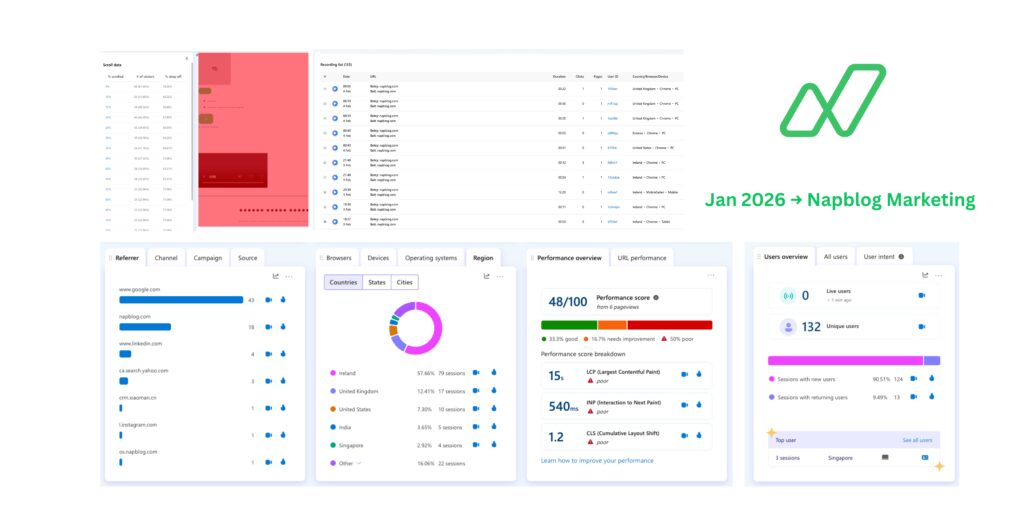
Why Heatmaps Became the Center of Napblog’s Marketing Decisions January 2026 marked a defining phase for Napblog’s website marketing maturity. Traffic volumes were still modest, but behavioral signals were exceptionally rich. Instead of relying on vanity metrics—pageviews, impressions, or raw sessions—Napblog deliberately anchored its entire website optimization strategy around heatmaps, session recordings, and real user behavior analytics. This article presents a full-stack, execution-level breakdown of how a modern business should use heatmap intelligence to: This is not theory. It is a practical, operational framework derived directly from Napblog’s January 2026 data. 1. Understanding Heatmaps as a Business Intelligence Layer Heatmaps are often misunderstood as design tools. In reality, they are decision-validation systems. Napblog used four primary behavioral data layers: Together, these layers expose truth, not assumptions. 2. Scroll Depth Analysis: Content Consumption vs. Content Length Key Observation (Jan 2026) Business Insight Search engines reward useful content, but users reward structured content. Long content alone does not equal engagement. On-Page Optimization Actions SEO Impact Lesson: Scroll depth is not about length—it is about momentum. 3. Click Heatmaps: Intent Mapping vs. Visual Guesswork Key Observation Business Insight Users do not read interfaces. They probe them. Click heatmaps reveal where users expect action, not where designers place it. On-Page Optimization Actions SEO Impact Lesson: Every dead click is a trust leak. 4. Session Recordings: Diagnosing Invisible Friction Heatmaps show where. Session recordings show why. Key Observation Business Insight SEO penalties increasingly stem from experience degradation, not keyword misuse. Session recordings exposed: On-Page Optimization Actions SEO Impact Lesson: If a user hesitates, the algorithm notices. 5. Performance Metrics + Heatmaps: When UX Becomes SEO January 2026 performance overview showed: Correlated Heatmap Findings Optimization Actions Strategic Insight Core Web Vitals are not abstract scores—they are behavior amplifiers. Poor performance doesn’t just slow pages; it reshapes user behavior, which feeds directly into ranking systems. 6. On-Page SEO Reframed: Behavior-First Optimization Napblog’s January approach redefined on-page SEO into five behavior-centric pillars: 1. Intent Clarity Users must understand the value proposition within 3–5 seconds. 2. Consumption Flow Content must guide users, not challenge them. 3. Interaction Affordance If something looks clickable, it must be clickable. 4. Performance Predictability Pages must feel stable and fast—even before they are fully loaded. 5. Engagement Signals Scroll, clicks, and dwell time must align naturally. Result: On-page SEO stopped being “optimization” and became experience engineering. 7. Off-Page Optimization: Quality of Traffic Over Quantity Heatmaps exposed a crucial truth: not all traffic is equal. Referrer Analysis Insights Off-Page Strategy Adjustments Heatmap-Driven Validation Off-page efforts were validated not by traffic spikes, but by: Lesson: Backlinks without behavioral alignment dilute SEO value. 8. Geographic & Device Insights from Behavioral Data Key Findings Strategic Actions Heatmaps ensured that localization decisions were data-driven, not assumption-driven. 9. Continuous Optimization: From Monthly Reports to Live Feedback Loops The most important shift Napblog made was operational, not technical. Old Model New Model (Jan 2026) Optimization Loop This loop transformed the website into a learning system, not a static asset. 10. How Any Business Should Apply This Framework Step-by-Step Blueprint Conclusion: Heatmaps Are the New SEO Compass Napblog’s January 2026 website marketing proves a critical reality: Search engines don’t rank websites.They rank user satisfaction at scale. Heatmaps translate abstract SEO advice into observable human behavior. They reveal where trust breaks, where intent fades, and where opportunity hides. For any modern business, the path forward is clear: In 2026 and beyond, the winners will not be those who “optimize for Google,” but those who optimize for humans—and verify it relentlessly.