
Napblog

February 3, 2026

people using Nap OS asked for it — clearly, repeatedly
NapOS

We Rebuilt the List View Filter — Because Listening Is Not a Feature, It’s a Discipline

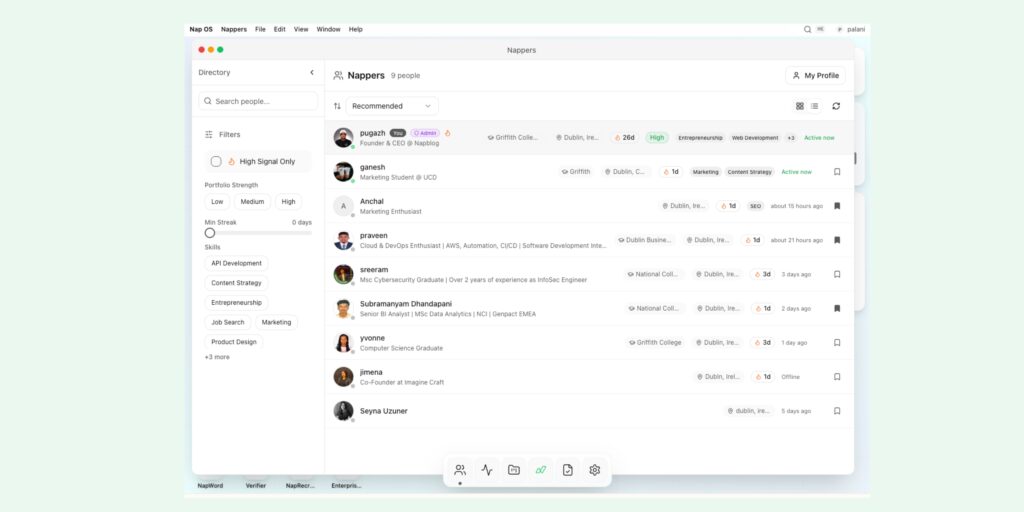
Most products talk about being user-first.Very few prove it at the infrastructure level. Last evening, after reviewing multiple user requests and real usage friction, we shipped a significant improvement to the List View Filter in Nap OS. Not because it was on a roadmap. Not because it looked good in a demo.But because people using Nap OS asked for it — clearly, repeatedly, and with context. This article is about why we rebuilt it, what changed, and what it says about how Nap OS is being built differently. The Reality: Lists Are Where Work Actually Happens Dashboards are impressive.Analytics are powerful.But lists are where decisions are made. Whether you are: You don’t live inside charts.You live inside lists. And when list views are slow, rigid, or misleading, productivity quietly collapses. We noticed that friction early. The User Signal We Couldn’t Ignore Over the last few weeks, users told us things like: None of these were bug reports.They were experience reports. That matters. Because bugs break products.But experience debt kills trust. Why the Old Model Wasn’t Enough The previous List View Filter worked functionally — but not intuitively. The problems were subtle but dangerous: That’s unacceptable for an operating system that claims to reduce cognitive load. So we paused.We reviewed usage.We replayed sessions.We listened. And then we rebuilt. What We Changed: The New List View Filter The updated List View Filter is not a cosmetic tweak.It is a behavioral upgrade. Here’s what changed at a structural level: 1. Filters Now Reflect Human Decision Flow Instead of asking users to adapt to system logic, the system adapts to how users actually evaluate people. You can now filter by: This mirrors how real evaluations happen — not how databases prefer to sort. 2. List View Is Faster Because Friction Is Removed, Not Hidden Speed is not animation.Speed is clarity. We removed: What remains is a list that responds immediately to intent. When you filter, you feel the system responding. 3. Signal Is Visible Without Opening Profiles One of the biggest complaints across professional platforms is this: “I have to open everything to understand anything.” We fixed that. Now, the list itself tells a story: Profiles become confirmation, not exploration. 4. Filters Are Built for Scale, Not Just Today’s Users This matters. Nap OS is not building features for: Filters are now designed to: Which means today’s improvement won’t become tomorrow’s bottleneck. Why We Shipped This Immediately Here’s something we believe deeply: If users are clear, waiting is disrespectful. We don’t batch “user pain” into quarterly updates.We don’t postpone clarity because of internal comfort. Nap OS listens 24×7 — not as a slogan, but as an operational rule. Last evening: No announcement-first mindset.No “coming soon” banners. Just execution. This Is Bigger Than a Filter This update represents something more important: A philosophy of product building. Nap OS is being built on three non-negotiable principles: 1. Infrastructure Over Interface Pretty UI without structural integrity collapses at scale. Every filter, list, and view in Nap OS is backed by: Which means what you see is not inflated, gamed, or cosmetic. 2. Users Are Co-Designers, Not Consumers We don’t treat feedback as “opinions”. We treat it as: If enough users struggle in the same place, the system is wrong — not them. 3. Trust Is Built in Small, Visible Wins Trust doesn’t come from whitepapers.It comes from moments like: The List View Filter update is one of those moments. Why This Matters for Students If you are a student using Nap OS: This update helps you: You don’t need louder profiles.You need clearer signal. Why This Matters for Recruiters If you are a recruiter or hiring manager: This update reduces: And increases: You don’t hire potential alone.You hire evidence of effort. Why This Matters for Founders & Builders If you are building or scaling a team: The improved List View Filter allows you to: That’s the difference between outsourcing and collaborating. What’s Next (And What Isn’t) We won’t promise features for the sake of announcements. But here’s what you can expect: What you won’t see: A Quiet Thank You to Users Who Spoke Up This update exists because people cared enough to say: “This could be better.” That’s not complaining.That’s participation. Nap OS is not built for users.It’s built with them. Closing Thought Products don’t fail because they lack features.They fail because they stop listening. Last evening’s List View Filter update is a small change with a big message: We’re here. We’re listening. And we’re building — continuously. If you’re using Nap OS already, explore the new List View.If you’re not, this is what you should expect when you join. Better tools don’t shout.They quietly make life easier. And that’s exactly what we intend to keep doing.
Homeschooling os , when combined with AI tools
HOS - Homeschooling OS

Pride in Homeschooling: Leading Children at Their Own Pace in the Age of AI

A New Kind of Parental Pride There is a quiet but profound pride emerging among modern parents—a pride not rooted in grades, rankings, or institutional validation, but in something far deeper: the ability to lead their children at their own pace. In the age of artificial intelligence, when information is abundant and automation is reshaping every profession, the old educational model feels increasingly misaligned. Parents are beginning to realize that the greatest gift they can give their children is not early acceleration or conformity, but alignment—with curiosity, with rhythm, with intrinsic motivation. Homeschooling, when combined with AI tools and first-principles thinking, enables something traditional schools structurally cannot: learning in a flow state, guided by parents who know their children better than any system ever could. This is not about rejecting schools out of fear. It is about stepping forward with confidence. It is about pride. 1. Ownership Is the New Status Symbol in Parenting For decades, parental success was measured externally: But the AI era has inverted that logic. Today, the most forward-thinking parents are asking a different question: “Do I truly understand how my child learns—and am I brave enough to design around that?” Taking ownership of a child’s education is no longer fringe behavior. It is becoming a marker of leadership, much like entrepreneurship once was. Homeschooling with AI does not mean parents must become subject-matter experts. It means they become architects of learning environments, curators of tools, and guardians of pace. That responsibility carries weight—and pride. 2. The Myth of “Same Age, Same Page” One of the most damaging assumptions in traditional education is the idea that children of the same age should be learning the same thing, at the same speed, in the same way. Neuroscience, psychology, and real-world observation all contradict this. Children differ radically in: Homeschooling breaks this illusion instantly. When parents remove artificial schedules, something remarkable happens: children settle into their natural learning rhythm. Some sprint. Some meander. Some dive obsessively into one topic for weeks. This is not inefficiency. This is how mastery actually forms. The concept aligns directly with the ideas popularized in Flow—deep focus occurs when challenge and skill are balanced, not forced. Schools optimize for coverage.Flow optimizes for absorption. 3. Flow State: Where Real Learning Happens Flow is not a productivity hack. It is a biological and psychological state in which: Traditional classrooms make flow nearly impossible: Homeschooling restores the conditions for flow: Parents who witness their child enter flow for the first time often describe it as transformational. The child is calm, alert, engaged—not performing, not resisting. There is a unique pride in recognizing that moment and knowing: “This happened because I gave them the space.” 4. AI as a Learning Amplifier, Not a Replacement Parent A common misconception is that AI will “teach children instead of parents.” In reality, AI removes the weakest parts of traditional schooling, not the human ones. AI excels at: Parents excel at: Together, they form a powerful system. AI handles repetition.Parents handle meaning. This partnership allows parents to step confidently into a role that was previously overwhelming. They no longer need to worry about “doing it wrong.” They can focus on guiding attention, not delivering lectures. The pride comes from stewardship, not control. 5. Leading Without Forcing: The Parent as Pace-Keeper In homeschooling, leadership does not mean constant instruction. It means: Children raised this way develop something rare: self-trust. They learn: Parents who honor their child’s pace are not “spoiling” them. They are training them in self-regulation, a skill far more valuable than early compliance. This is where parental pride deepens—from achievement-based pride to character-based pride. 6. Redefining Success in the AI Future The future does not reward: It rewards: Homeschooling aligned with AI trains exactly these traits. When children grow up accustomed to: They do not fear AI. They collaborate with it. Parents who recognize this early experience a justified pride—not because their child is “ahead,” but because they are future-ready. 7. Pride Without Ego: A Quiet Confidence This new parental pride is not loud or defensive. It does not need to argue with skeptics. It shows up as: Parents stop outsourcing authority and start trusting observation. They see their children not as projects to optimize, but as systems to harmonize with. That shift—from control to coherence—is the defining move of homeschooling in the AI era. 8. The Deeper Truth: You Were Always the Best Guide Technology did not make homeschooling possible. It made it obvious. Parents have always been the most context-aware educators in a child’s life. AI simply removed the logistical barriers that once made that role feel impossible. To homeschool your child at their own pace is not an act of rebellion. It is an act of responsible leadership. And taking that responsibility—fully, consciously, proudly—may be one of the most meaningful decisions a parent can make in this century. Closing Reflection The future will not ask where your child went to school. It will ask: Parents who lead their children in flow—supported by AI, grounded in trust—already know the answer. And they carry that knowledge with quiet, earned pride.