
Napblog

February 1, 2026

NapReport: Granular Activity Logging & Verifiable Productivity Intelligence Across Nap OS
Blog

NapReport: Granular Activity Logging & Verifiable Productivity Intelligence Across Nap OS

productivity is one of the most discussed—and least precisely measured—concepts. Recruiters want proof of execution, lecturers want evidence of learning continuity, and managers want visibility into where effort compounds or leaks. Yet most systems still rely on self-reported summaries, static resumes, or shallow metrics like hours logged or tasks completed. NapReport, a core NapApp within the Nap OS ecosystem, fundamentally changes this paradigm. NapReport is not a dashboard.It is not a time tracker.It is not another performance scorecard. NapReport is a granular, verifiable, system-level activity intelligence layer—built to translate daily execution into trustworthy, decision-grade signals. This article explores NapReport in depth: its philosophy, architecture, use cases, and why it enables recruiters, lecturers, and managers to finally see where productivity overlaps, compounds, or breaks down. 1. The Problem: Productivity Without Proof 1.1 The Resume Illusion Traditional resumes compress years of effort into bullet points: But how was that improvement achieved? There is no verifiable execution trail. 1.2 The Manager’s Blind Spot Managers face a different problem: By the time a report shows “low productivity,” the opportunity to intervene has already passed. 1.3 Academic & Training Gaps Lecturers and mentors often assess: But they miss: Execution behavior remains invisible. 2. NapReport’s Core Idea: Execution Is the Signal NapReport is built on a single premise: Execution patterns are more truthful than outcomes alone. Instead of asking what someone claims to have done, NapReport answers: NapReport achieves this by transforming Nap OS’s continuous activity stream into a structured, verifiable, and exportable intelligence report. 3. Granular Activity Logging: The Foundation 3.1 Atomic Activity Capture Every action within Nap OS—across apps like Tracker, Projects, Napblog, Nappers, Portfolio, and Reports—is logged as an atomic event: No batching.No retroactive editing.No vague summaries. This ensures chronological integrity. 3.2 Activity Types NapReport classifies activity into granular categories: This classification allows NapReport to move beyond “activity count” into activity quality analysis. 4. Execution & Discipline: Measuring What Actually Matters One of NapReport’s most powerful sections is Execution & Discipline. 4.1 Streak Intelligence (Not Gamification) NapReport distinguishes between: This is not gamified motivation—it is behavioral reliability modeling. Recruiters can instantly assess: 4.2 High-Signal Work Detection NapReport identifies high-signal activities: This allows stakeholders to see: 5. Overlapping Productivity: Seeing Compounding Effort One of NapReport’s most valuable contributions is overlap detection. 5.1 What Is Productivity Overlap? Overlap occurs when: NapReport reveals: 5.2 Why This Matters For recruiters: NapReport surfaces this implicitly—without self-reporting bias. 6. Plug Points: Identifying Productivity Leaks NapReport does not only highlight strengths—it reveals plug points. 6.1 Execution Drop-Offs NapReport timeline views show: This allows early intervention. 6.2 Imbalance Detection Examples: Managers can course-correct before outcomes suffer. 7. Verification: Trust Without Micromanagement 7.1 System-Level Authenticity NapReport data is: There is no need for: 7.2 Attachments & Evidence Users can optionally attach: Each attachment is: This creates soft verification, not intrusive oversight. 8. Use Case Deep Dive 8.1 Recruiters & Hiring Teams NapReport replaces: With: Hiring becomes signal-driven, not intuition-driven. 8.2 Lecturers & Academic Institutions NapReport enables: Assessment shifts from what was submitted to how learning occurred. 8.3 Managers & Team Leads Managers gain: Without: 9. NapReport as a Shareable Artifact 9.1 Exportable Intelligence NapReport can be: This makes NapReport: 9.2 Cover Letters & CV Integration Users can attach: Together, they form a complete professional narrative. 10. Why NapReport Is Different From Analytics Tools Traditional Analytics NapReport Retrospective Continuous Outcome-based Execution-based Aggregated Granular Self-reported System-generated Static dashboards Living reports NapReport is not about productivity measurement—it is about productivity understanding. 11. Cultural Impact: From Surveillance to Signal NapReport does not punish inactivity.It does not rank humans.It does not enforce hustle. Instead, it: This is critical for the future of work, education, and collaboration. 12. Conclusion: A New Standard for Verifiable Work NapReport represents a structural shift: By enabling granular activity logging and verification across Nap OS, NapReport empowers recruiters, lecturers, and managers to finally answer the hardest productivity questions: In an economy driven by execution—not titles—NapReport becomes more than a NapApp. It becomes the operating proof of professional discipline.
Jan 2026 → Napblog Marketing Data Analysis
Blog

Jan 2026 → Napblog Marketing Data Analysis

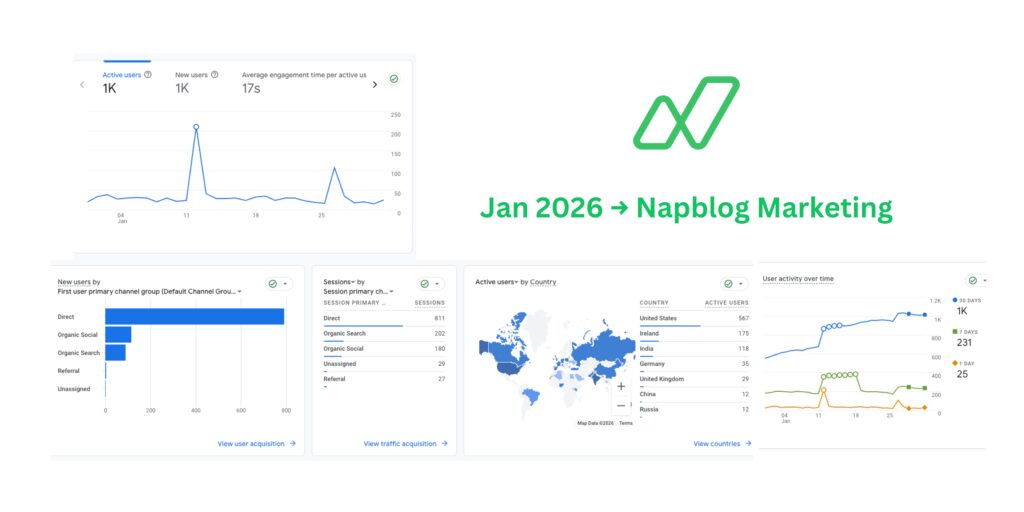
January 2026 marks a decisive inflection point for Napblog. In less than one month, the platform recorded 1,032 active users, 1,005 new users, and 1,248 total sessions, with ~65% of all sessions classified as Direct traffic. There was zero paid acquisition, zero revenue, and no traditional performance marketing funnel. Yet Napblog achieved global reach across 46 countries, consistent daily activity, and repeat engagement patterns that typically appear only after prolonged brand exposure. This is not accidental growth.This is distribution by design. The analytics snapshot from January 2026 is not a growth report in the conventional sense—it is a case study in behavioral SEO, brand gravity, and intent-first traffic engineering. 1. Context: Why These Metrics Matter More Than They Look At surface level, skeptics may dismiss the numbers: But this interpretation is shallow. Napblog was not optimizing for: Napblog was optimizing for recognition, return intent, and direct recall. In that context, the dominance of Direct traffic (811 sessions / 64.98%) becomes the most important signal in the entire dataset. Direct traffic at this stage does not mean “typed URL only.” In modern GA4 semantics, it means: For a young brand, this is extremely rare. 2. The Core Signal: Direct Traffic as Proof of Brand Gravity Channel Breakdown (Sessions) Channel Sessions % Share Direct 811 64.98% Organic Search 202 16.19% Organic Social 180 14.42% Referral 27 2.16% Unassigned 29 2.32% This distribution violates the standard early-stage growth curve. Normal early-stage pattern: Napblog pattern: This indicates pre-formed intent before arrival. Napblog is not being “found.”Napblog is being remembered. 3. Why Napblog Achieved Direct Traffic So Early 3.1 Distribution Happened Before Analytics Napblog’s growth did not begin inside GA4.It began outside the browser: By the time users arrived, the decision was already made. This is why Direct traffic surged immediately instead of slowly compounding. 3.2 Napblog Is Not a Content Site — It Is a Cognitive Anchor Traditional content marketing asks: “What keywords should we rank for?” Napblog asked: “What ideas should people carry with them?” As a result: This explains why Organic Search traffic (202 sessions) has: Organic Search is deep, not broad. 4. Behavioral Evidence: Engagement Quality by Channel Engagement Metrics by Channel Channel Engagement Rate Avg Time Events/Session Direct 18.5% 6s 3.47 Organic Search 49.01% 35s 4.94 Organic Social 41.67% 29s 4.01 Referral 55.56% 7s 4.48 Interpretation: This is a healthy intent stack, not random traffic. 5. Geography: Proof of Conceptual Virality Top Countries by Active Users Country Active Users Avg Engagement United States 567 7s Ireland 175 39s India 118 26s United Kingdom 29 45s Germany 35 16s Key insight: Napblog reached 46 countries with no localization strategy. That only happens when: 6. Retention & Cohorts: Why Napblog Didn’t Chase Stickiness Cohort Retention Snapshot (6 Weeks) This looks “bad” under SaaS metrics. But Napblog is not a tool.It is a thinking surface. Users return: This is episodic retention, not habitual retention. 7. Page-Level Behavior: Where Attention Actually Goes Top Pages by Views Page Views Homepage 375 NapOS 46 Sales 46 NapblogOS 43 404 Page 34 Join NapOS Waiting List 33 Insights: This is curiosity-led navigation, not funnel-led navigation. 8. Event Data: Users Don’t Click Much — They Read Event Counts This confirms: This aligns with Napblog’s philosophy: Do not convert attention. Earn it. 9. Why Revenue Is $0 — And Why That’s Strategic Napblog did not monetize January 2026 traffic because: Instead, Napblog optimized for: Revenue will follow after gravity stabilizes. 10. The Real Strategy: Engineering “Direct” as a Channel Napblog treats Direct traffic as a product, not a byproduct. That means: Most brands chase: Napblog chased: 11. Why This Is Pure Domination (Without Competition) There was no competition because: You cannot outbid this.You cannot keyword-match this.You cannot copy this with tools. This took years of backend research, SEO deconstruction, behavioral observation, and deliberate restraint. That’s why it looks easy now. 12. Final Takeaway January 2026 is not Napblog’s growth month.It is Napblog’s proof month. Proof that: This is not growth hacking.This is growth architecture. And this is only the beginning.

homeschooling is no longer a fringe choice
HOS - Homeschooling OS

Homeschooling Adoption Rate in 2026: Forecast, Trends, and the Bigger Shift in Education

If we look at education in 2026 honestly, one thing is impossible to ignore: homeschooling is no longer a fringe choice. It has moved from the margins into mainstream conversations among parents, policymakers, and even governments. What once sounded radical is now being discussed at kitchen tables, parent forums, and national education panels. The question in 2026 is no longer “Why would someone homeschool?”It is “Why are so many families leaving the traditional school system?” This article explores homeschooling adoption rates in 2026, forecasts where they are heading, and—more importantly—why this growth is happening at a structural level. 1. Homeschooling in 2026: From Alternative to Accepted Until the early 2010s, homeschooling was often associated with a very narrow demographic: religious families, remote rural households, or parents dissatisfied with local schools. That picture is outdated. By 2026, homeschooling has become: In countries like the United States, homeschooling participation has crossed from roughly 3% pre-COVID to an estimated 6–7% of K–12 students by 2026, depending on state regulations and data sources. That represents millions of children. Across Europe, adoption is slower but steadily rising. In Ireland, official registrations for home education have nearly doubled since the early 2020s, with noticeable spikes after 2024. Reports from RTÉ and coverage by BBC reflect a similar pattern across the UK. This is not a temporary spike. It is a structural shift. 2. Global Adoption Rate Forecast for 2026 Let’s talk numbers—not as rigid statistics, but as directional indicators. Estimated Homeschooling Adoption (2026) What matters more than raw percentages is growth velocity. Homeschooling markets globally are expanding at 8–12% CAGR, significantly outpacing population growth and traditional school enrollment. That tells us something important: families are actively opting out, not passively drifting in. 3. Why Homeschooling Is Growing in 2026 (The Real Reasons) Most articles stop at surface explanations—COVID, flexibility, safety. Those factors started the movement, but they do not explain why homeschooling continues to grow in 2026. The real drivers are deeper. 1. The Traditional School Model Is Expired The industrial school system was designed for: In an AI-driven economy, this model feels painfully outdated. Parents see children: By 2026, parents are no longer debating if this model is broken. They are debating how fast to exit it. 2. AI Has Changed the Value of Schooling When AI can: Parents naturally ask:Why must my child learn at the pace of the slowest or fastest student in a class of 30? Homeschooling in 2026 is not anti-technology. It is technology-leveraged learning. 3. Mental Health and Burnout By 2026, student anxiety, burnout, and disengagement are openly discussed. Parents see: Homeschooling offers psychological breathing room. 4. Ireland as a Case Study: Small Country, Clear Signal Ireland provides a clean case study because homeschooling there is: Yet adoption is rising every year. Between 2020 and 2026: This is crucial. It proves homeschooling growth is not a crisis response, but a conscious educational philosophy shift. Irish parents increasingly cite: Homeschooling is becoming a preventive decision, not a last resort. 5. Market Signals: Follow the Infrastructure Another way to forecast adoption is to observe support infrastructure. By 2026: …are all expanding rapidly. The global homeschooling services market is projected to grow from single-digit billions in the early 2020s to tens of billions by the early 2030s. Markets do not grow like this unless demand is real and sustained. This also tells us something important:Homeschooling is no longer “parents doing everything alone.” 6. Who Is Choosing Homeschooling in 2026? One of the biggest misconceptions is that homeschooling is only for: In 2026, the demographic profile is far broader: Common Profiles This diversity strengthens adoption rates because homeschooling is no longer tied to a single ideology. 7. Governments’ Changing Attitude in 2026 In the early years, governments viewed homeschooling defensively. By 2026, the tone has shifted. Many states and countries now: Why? Because governments are also facing: Homeschooling quietly reduces system load. 8. Forecast Beyond 2026: Where Is This Going? If current trends continue: But the bigger shift is not numbers. It is normalization. By the end of the decade: 9. Homeschooling OS: The Systemic Explanation What we are witnessing in 2026 is not just homeschooling growth—it is system replacement logic. Traditional school systems optimize for: Homeschooling OS optimizes for: Parents are not rejecting education.They are rejecting obsolete architecture. 10. Final Thought: 2026 Is the Tipping Point Homeschooling adoption in 2026 marks a psychological tipping point. Even families who do not homeschool now: That mindset shift is irreversible. Homeschooling is no longer “against the system.”It is what happens when the system no longer serves its purpose.

The Good Things Happening for International Students
SIOS - Students Ireland OS

2026 Overview: The Good Things Happening for International Students

For much of the past decade, international students have lived with uncertainty. Visa rule changes, rising tuition fees, housing shortages, geopolitical tensions, and post-pandemic disruptions made global education feel fragile. Yet 2026 marks a clear turning point. While challenges still exist, the overall direction of international education has shifted toward flexibility, diversification, and employability. Instead of relying on a small group of traditional destinations, students now have more choice, better value, and smarter pathways to global careers. Universities, governments, and employers are increasingly aligned around one idea: international students are not a burden—they are essential contributors to innovation, economic growth, and global talent pipelines. This article offers a comprehensive, forward-looking overview of the good things happening for international students in 2026, focusing on destinations, visas, education models, employability, student support, and financial accessibility. 1. A Shift Away from “Big Four” Dependency One of the most positive developments in 2026 is the decentralization of global student mobility. For years, the United States, United Kingdom, Canada, and Australia dominated international education. While they remain important, tighter caps, higher costs, and policy uncertainty have pushed students to explore new, often better-balanced alternatives. Europe Becomes the Smart Choice Countries like Germany, France, and Netherlands are attracting record numbers of international students. Asia Emerges as a Global Education Hub Asia’s rise is no longer speculative—it’s structural. Ireland’s Strategic Advantage Ireland stands out in 2026 as a uniquely balanced destination: For students seeking European exposure without language barriers, Ireland has become a high-ROI destination. 2. Visa Reforms and Post-Study Work: From Uncertainty to Opportunity Another major positive trend in 2026 is the reframing of international students as future workers, not temporary visitors. More Flexible Post-Study Work Options Several countries have aligned education policy with labor market needs: This shift matters. It reduces pressure, improves mental well-being, and allows students to build careers gradually instead of racing against visa deadlines. Clearer Employer Participation Employers are now more involved in visa pathways: For international students, this means education is no longer disconnected from employment—it is intentionally designed to lead there. 3. The Rise of Future-Ready and Hybrid Education Models The traditional “four years on campus, one degree, one outcome” model is fading. In 2026, international education is more modular, flexible, and skills-oriented. Hybrid Learning as a Cost-Saver Many universities now allow students to: This model is especially beneficial for students from developing economies, making global education more accessible without compromising quality. In-Demand, Employability-Driven Fields Curricula increasingly focus on: These are not abstract academic trends—they align directly with global skill shortages, improving internship access and job placement. Micro-Credentials and Stackable Learning Short-term certificates and micro-credentials have grown by over 30% in the last five years. Students can now: For international students, this reduces risk and increases career optionality. 4. Better Student Support and a Stronger Focus on ROI In 2026, universities are finally being held accountable not just for enrollment numbers—but for student outcomes. Mental Health and Well-Being Support services have expanded significantly: This reflects a long-overdue recognition that international students face unique pressures—cultural adjustment, financial stress, and visa anxiety. Skill-Based and Holistic Admissions Admissions are slowly moving away from: Instead, more institutions value: This benefits non-traditional students and professionals returning to education. Alumni Networks and AI-Driven Mentorship Platforms using AI now connect students with: The result is measurable: higher interview rates and stronger job pipelines, especially for international graduates who previously lacked local networks. 5. Financial Accessibility Improves—Despite Global Inflation Cost remains a concern, but 2026 offers more strategic affordability than before. Targeted Scholarships Scholarships are increasingly aligned with: These are not generic awards—they are talent investments by governments and institutions. Lower Living Costs Outside Major Cities Students are choosing: This significantly lowers rent and daily expenses compared to cities like London, New York, or Sydney—without sacrificing academic quality. Best Countries for International Students in 2026 (Snapshot) Based on 2025–2026 trends: Each of these destinations reflects a broader trend: value, clarity, and employability matter more than prestige alone. Conclusion: The Future of International Education Is More Balanced—and More Human 2026 does not represent a return to the old “easy migration” era. Instead, it signals something better: a more intentional, transparent, and student-centered global education system. International students today are: And institutions are finally responding—by improving support, aligning education with work, and recognizing international students as partners in global progress, not temporary guests. For those willing to look beyond outdated rankings and explore emerging pathways, 2026 may be one of the most promising years yet to study abroad.

EU AI Act Pharma Napblog Limited
AIEOS - AI Europe OS

AI Europe OS Perspective: Cheap, Compliant AI Solutions for the European Pharmaceutical Industry

The European pharmaceutical industry faces a structural paradox: it is one of the most data-rich and regulation-intensive sectors in the world, yet many small- and mid-size pharma and biotech firms lack the capital to adopt large-scale artificial intelligence systems pioneered by US and Chinese multinationals. From an AI Europe OS perspective, the answer is not “more AI spend,” but cheaper, targeted, sovereign, and compliance-first AI adoption. This article outlines how cost-efficient AI solutions, grounded in open-source models, EU-hosted infrastructure, and risk-classified deployment, can deliver tangible value across drug discovery, clinical operations, manufacturing, quality, supply chain, and regulatory compliance—without violating GDPR, GxP, or the EU AI Act. 1. Why “Cheap AI” Matters in European Pharma Unlike Big Pharma giants, over 70% of European pharma companies fall into the SME or mid-cap category. These firms face: From an AI Europe OS viewpoint, cheap AI does not mean low quality. It means: The goal is operational leverage, not speculative AI moonshots. 2. Regulatory Reality: Designing AI Under the EU AI Act The EU AI Act fundamentally reshapes pharma AI economics. AI systems used in: are likely to be classified as high-risk systems. Cheap AI strategies must therefore prioritize: This makes open-source European models (e.g. Mistral-class LLMs) economically superior to opaque US SaaS tools when compliance costs are factored in. 3. Low-Cost AI in Drug Discovery and Early R&D Cost-Efficient Use Cases Instead of replacing wet labs, AI should reduce failed experiments: Using Python-based ML stacks, open datasets, and EU compute, companies can achieve 20–40% cost reductions in early screening. Key principle: AI as a filter, not a creator. This approach is already being validated by European leaders such as Sanofi, which focuses on AI-augmented decision layers rather than full automation. 4. Cheap AI for Clinical Trials and Operations High-ROI, Low-Risk Applications Clinical AI does not need deep learning at scale to be effective. Cost-efficient deployments include: By using retrieval-augmented generation (RAG) over internal trial documents, companies avoid sending sensitive data to external APIs—dramatically reducing compliance costs. This aligns with EMA expectations and minimizes AI Act exposure. 5. Manufacturing, GMP, and Quality Control Automation Where Cheap AI Delivers the Fastest Payback Manufacturing is where AI Europe OS sees the highest ROI per euro spent. Low-cost AI solutions include: These systems often run on edge devices and do not require expensive cloud inference. Critically, they also remain outside patient-facing AI risk categories, simplifying regulatory obligations. 6. AI-Driven Regulatory and Compliance Automation Regulatory overhead is one of the most expensive hidden costs in pharma. Cheap AI can: By deploying internal LLMs trained on company SOPs, firms reduce dependency on external consultants while maintaining full data sovereignty. This is one of the most underestimated cost-saving AI use cases in Europe. 7. Supply Chain and Shortage Prevention European drug shortages are a structural problem. Cheap AI can mitigate—not eliminate—risk through: These models rely on time-series analytics, not large generative systems, making them cheap, stable, and explainable. 8. Infrastructure Choices: Keeping AI Affordable From an AI Europe OS lens, infrastructure decisions determine long-term AI cost. Recommended stack: Avoid architectures that require continuous API calls to non-EU vendors—these create regulatory debt. 9. Public Funding and Ecosystem Leverage European pharma companies systematically underuse: Strategic participation can subsidize 30–60% of AI implementation costs, making “cheap AI” even cheaper. 10. Strategic Principles for Cheap AI in Pharma From the AI Europe OS perspective, success depends on five principles: Companies that follow these principles will outperform better-funded competitors who deploy AI irresponsibly. Conclusion: From AI Hype to Sustainable Advantage Cheap AI is not a compromise—it is a European competitive strategy. By focusing on cost-efficient, regulation-aligned, sovereign AI systems, the European pharmaceutical industry can: AI Europe OS sees the future of pharma AI not in trillion-parameter models, but in well-governed, purpose-built intelligence embedded into everyday operations.