
Napblog

January 28, 2026

Choosing AI Host Services for SMBs
AIEOS - AI Europe OS

Choosing AI Host Services for SMBs (50+ Headcount) Strategic, Technical, and Regulatory Factors for AWS, Azure, and Beyond

1. Executive Context: Why Hosting Choice Matters for AI Europe OS For small and medium-sized businesses (SMBs) with 50+ employees, infrastructure decisions are no longer purely IT concerns. Under AI Europe OS principles—data sovereignty, compliance-by-design, and pragmatic AI adoption—the choice of hosting provider directly impacts: Unlike startups that prioritize speed at all costs, SMBs must balance innovation with stability. This article provides a structured framework for choosing host services (AWS, Microsoft Azure, Google Cloud, and EU-first alternatives) specifically through the lens of AI Europe OS. 2. SMB Infrastructure Profile (50+ Headcount) Before comparing providers, it is critical to define a typical SMB infrastructure baseline. 2.1 Common Characteristics 2.2 AI Workload Types These workloads require reliable compute, predictable storage, and secure data boundaries, not hyperscale experimentation. 3. Core Hosting Decision Factors (AI Europe OS Framework) 3.1 Data Sovereignty & Jurisdiction Key Question: Where does your data legally reside, and who can access it? Factors to assess: AI Europe OS Principle: Data should remain European by default, with transparent legal exposure. 3.2 Regulatory Compliance (GDPR, AI Act, ISO) SMBs must assume audits will increase. Minimum requirements: Hosting providers should reduce compliance burden—not increase it. 3.3 Cost Predictability Cloud failures for SMBs are often financial, not technical. Evaluate: Anti-pattern: Low entry cost with runaway monthly bills. 3.4 Scalability vs Overengineering SMBs rarely need hyperscale elasticity. Right-sizing matters: 3.5 Security & Identity Management Non-negotiable controls: Security must be configurable without a 10-person security team. 3.6 Vendor Lock-in Risk AI Europe OS emphasizes strategic autonomy. Assess: 4. AWS for SMBs (50+ Headcount) 4.1 Strengths 4.2 Weaknesses 4.3 Suitable Use Cases 4.4 Key AWS Technical Specs AI Europe OS Verdict: Powerful but requires governance discipline. 5. Microsoft Azure for SMBs 5.1 Strengths 5.2 Weaknesses 5.3 Suitable Use Cases 5.4 Key Azure Technical Specs AI Europe OS Verdict: Best balance of usability, compliance, and AI readiness for SMBs. 6. Google Cloud Platform (GCP) 6.1 Strengths 6.2 Weaknesses 6.3 Suitable Use Cases AI Europe OS Verdict: Technically strong, strategically less aligned for conservative SMBs. 7. EU-First & Sovereign Cloud Alternatives 7.1 OVHcloud 7.2 Scaleway 7.3 IONOS Cloud AI Europe OS Perspective: Ideal for sensitive workloads or hybrid strategies. 8. Hybrid & Multi-Cloud Strategies for SMBs Contrary to hype, selective hybrid is often optimal: Avoid full multi-cloud unless justified by regulation. 9. AI-Specific Hosting Considerations 9.1 Compute 9.2 Data Pipelines 9.3 Model Governance 10. Decision Matrix (Simplified) Factor AWS Azure GCP EU Cloud Ease for SMB Medium High Medium High Compliance High Very High High Very High AI Services Very High High Very High Medium Cost Control Medium High Medium High Sovereignty Medium Medium Medium Very High 11. AI Europe OS Recommendation For SMBs (50+ headcount): 12. Conclusion Choosing a hosting provider is a strategic governance decision, not a procurement task. Under AI Europe OS, SMBs must optimize for: The right choice is rarely the biggest platform—but the one that aligns infrastructure with European values, compliance realities, and sustainable AI adoption.
Uncategorized

A Native Learning Operating System for the AI Age. Homeschooling OS

Why Children Need an Operating System, Not More Apps? Children today are growing up inside systems they did not design. Algorithms decide what they watch, platforms shape how they communicate, and artificial intelligence increasingly fills gaps that were once occupied by curiosity, patience, and human guidance. Parents are right to ask an uncomfortable question: are our children learning naturally, or are they being trained by machines? Homeschooling OS is a response to that question. Inspired conceptually by ideas such as Nap OS—which reimagines rest and recovery as systems rather than habits—Homeschooling OS reframes learning itself as an operating system. Not a piece of software. Not a screen. But a structured, human-first framework that governs how children think, learn, communicate, and grow. This article introduces the idea to parents in clear, practical language. It explains how children can be guided toward native learning—learning that emerges naturally from curiosity and interaction—while remaining AI-neutral, meaning AI is neither banned nor allowed to replace foundational human development. What Is Homeschooling OS? An operating system, in simple terms, is the invisible layer that makes everything else work. It determines priorities, rules, and flows. When applied to children’s learning, an OS answers questions like: Homeschooling OS is a learning philosophy and practical framework designed around three core ideas: It does not compete with schools, curricula, or parents. Instead, it acts as a baseline system that ensures children grow with clarity, confidence, and independence—before outsourcing thinking to machines. Native Learning: How Children Are Designed to Learn Before screens, before apps, before assessments, children learned naturally. This process is still intact—but easily disrupted. Native learning is built on six pillars: When technology intervenes too early or too aggressively, these pillars weaken. Homeschooling OS does not reject technology—it protects these foundations first. AI-Neutral Learning: A Critical Distinction for Parents There is a growing misconception that children must be AI-native to succeed. In reality, what they must be is cognitively native. AI-neutral learning means: This is the same principle as learning arithmetic before calculators or spelling before spellcheck. An AI-dependent child may appear advanced—but often lacks: Homeschooling OS advocates delayed reliance, not denial. Communication Before Computation One of the most overlooked truths in education is this: thinking develops through language. Children who can explain an idea clearly usually understand it. Children who cannot often rely on memorisation or tools. Homeschooling OS places natural communication at the centre of learning: For parents, this does not require expertise—only presence. Instead of asking: “Did you get the right answer?” Ask: “Can you tell me how you thought about it?” This single shift strengthens reasoning, confidence, and independence. How Parents Can Teach Naturally (Without Teaching) Parents often feel pressure to teach—to explain, correct, and optimise. Native learning works best when parents facilitate, not dominate. Practical principles: Simple daily practices: These micro-moments build a powerful internal OS. Age-Based Guidance: What AI-Neutral Looks Like in Practice Ages 3–6 Ages 7–10 Ages 11–14 The principle remains constant: skills before shortcuts. Why This Matters for Ireland’s Future Ireland’s strength has always been its people—adaptable, communicative, resilient, and community-oriented. In a global AI economy, these human qualities will matter more, not less. Homeschooling OS aligns with: By protecting native learning now, Ireland can raise a generation that uses AI wisely instead of being shaped by it. What Homeschooling OS Is Not To be clear, this is not: It is a framework for intentional growth. It trusts parents. It respects children. And it recognises that intelligence is more than speed, output, or optimisation. Conclusion: Raising Humans First The most important question for parents today is not: “Is my child keeping up with technology?” But: “Is my child developing the inner systems to use it wisely?” Homeschooling OS offers a calm, grounded answer. By prioritising native learning, natural communication, and AI-neutral development, parents can help children grow into confident, capable humans—before they become users of advanced tools. In a world rushing toward automation, raising humans first may be the greatest advantage of all.

Launch Story 1 — A Decade in the Making
NapOS

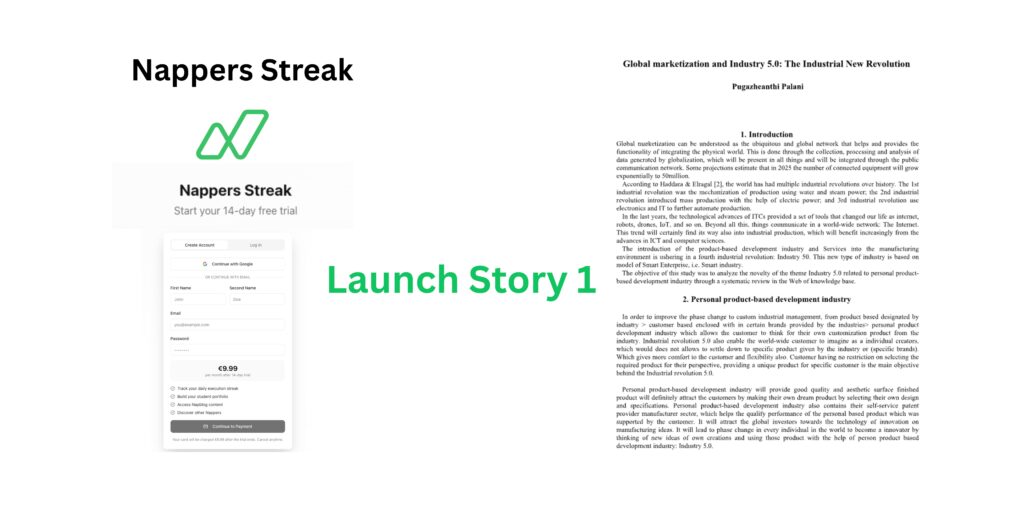
Nappers Streak, Launch Story 1 — A Decade in the Making

From a journal submission to a global system in human hands Thursday, January 28, 2016 Ten years ago, this was not a product launch day. There was no landing page.No pricing tier.No streak counter.No users waiting. There was only a document. A young boy sat with a question that felt heavier than his age: Why does technology scale faster than humans—but never with them? That question became a proposal.That proposal became a submission.An International Journal Competition entry titled: “Global Marketization and Industry 5.0: The Industrial New Revolution.” It was not written to impress investors.It was written to understand the future. At its core, the paper argued something radical for 2016: Instead, the next revolution must return power to the individual. Not as a consumer.Not as a data point.But as a creator. That was the seed. No one called it Nap OS then.No one imagined a streak.But the direction was set. 2016–2018: The Idea That Refused to Sit Still After submission, the paper did not end. It followed everywhere. Into classrooms.Into late-night notebooks.Into rejected ideas.Into abandoned prototypes. The world spoke about: But the original question persisted: Where does the human go when systems become perfect? Early answers were naive.Some were wrong.Many failed completely. But one truth kept resurfacing: Humans don’t need more tools.They need continuity. People weren’t failing because they lacked intelligence.They were failing because nothing compounded. Every system reset them to zero. 2019–2021: Iterations Without Applause These were quiet years. No announcements.No social validation.Only iterations. Thousands of them. Experiments that broke after 3 days.Systems people loved—but didn’t return to.Dashboards that felt powerful—but changed nothing. Each failure revealed something precise: Fragmentation is. Humans were being forced to live in disconnected moments:Learning here.Working there.Proving somewhere else. Nothing remembered them. So the system had to. 2022–2024: The Architecture Emerges At some point, the work stopped being about features. It became about philosophy made executable. Three principles locked in: This was the birth of Nap OS—not as software, but as an operating system for human continuity. Not another productivity app.Not another AI assistant. But a system that: Still, it wasn’t ready. Because one final problem remained. The Hardest Problem: Starting Nap OS was powerful. But power alone doesn’t change lives. Starting does. People didn’t need the whole system on day one.They needed proof they could show up tomorrow. That insight took thousands more iterations. Until everything collapsed into one primitive, undeniable unit: The Streak Not a gamified number.Not motivation theater. But a living record of kept promises. 2025: Nappers Streak Is Born Nappers Streak became the smallest, sharpest entry point into Nap OS. One daily action.One visible mark of consistency.One signal to the system: I showed up. That was enough. Behind the scenes, Nap OS began doing what it was always meant to do: Quietly. Reliably. Daily. Today — January 28 Ten years after a journal submission. Ten thousand iterations later. What began as a theory about Industry 5.0—where individuals reclaim creative and productive agency—now lives in human hands. Today, we launch Nappers Streak. Not as a feature.Not as a habit tracker.But as the first public interface of Nap OS. A Thank You, Written Between the Lines This launch belongs to every hand that pushed the boy forward: Most of all, it belongs to the invisible moments:The days no one saw.The work that didn’t trend.The belief that refused to expire. What This Launch Really Means Nappers Streak is not the destination. It is the beginning of a system that grows with you. Every streak is an atom.Every atom compounds.Every compound builds identity. This is not about doing more. It is about becoming continuous. From a Young Dream to Global Hands Ten years ago, this was a document. Today, it is a system. And from today onward, it is yours. Welcome to Nap OS.Welcome to Nappers Streak. The future didn’t arrive overnight.It arrived one day at a time.